



How Many Rest Days Do You Need Between Workouts?
For a beginner doing full body strength training a practical starting rule is to leave at least one full day without hard strength work for the same muscles. Monday and Wednesday sessions are one example. That is roughly 48 hours when both workouts happen at the same time of day.
The quick answer. Allow at least one full recovery day between demanding strength sessions for the same muscle group. Some sessions or people need longer. Plan at least one day each week without a structured workout as a simple starting arrangement and add more recovery when your schedule and response call for it.
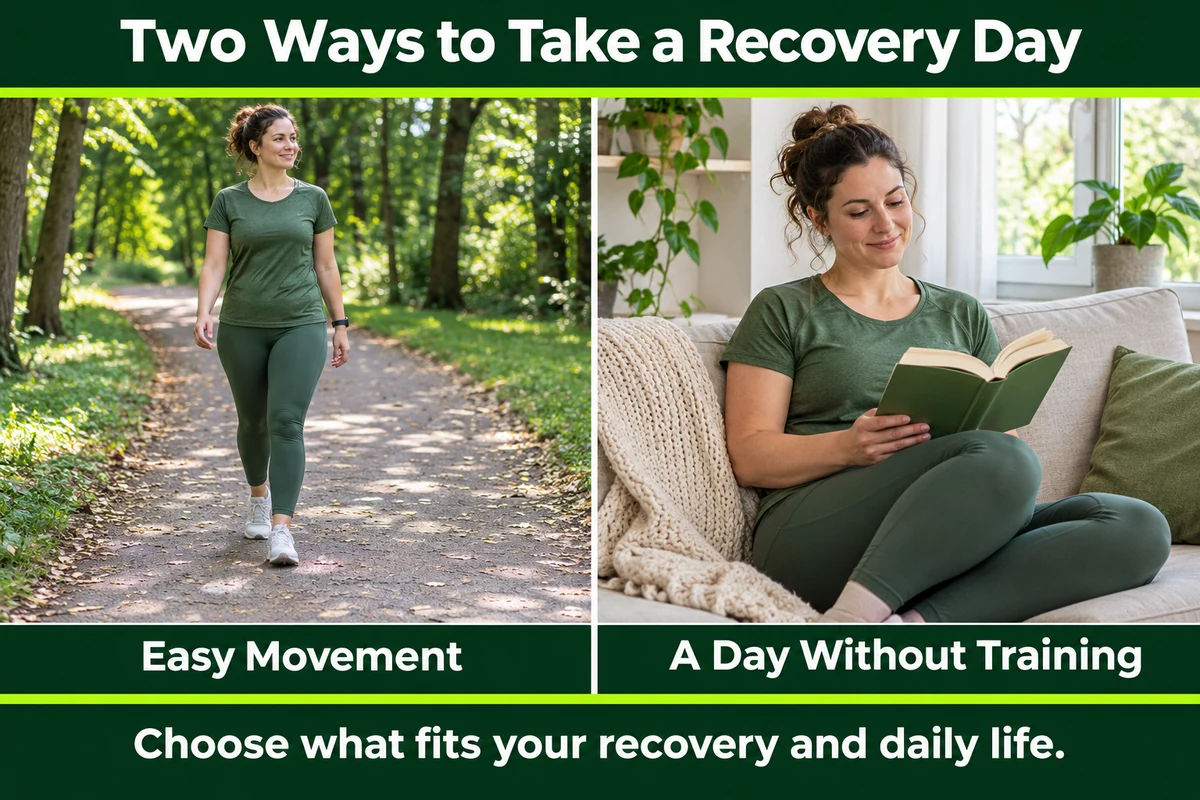
A rest day from lifting does not always mean avoiding all movement. Comfortable walking may fit. An intense run or a hard exercise class is another training session even if you call it active recovery.
This guide answers how many rest days between workouts make sense by separating three different questions. How long should a muscle recover. How should hard sessions fit together. And when is a whole day without training useful. You will find example weeks and a practical readiness check without treating a calendar rule as proof that you have recovered.
First decide what you mean by a rest day
The phrase rest day is used for several different arrangements. One person means no gym visit. Another means a light walk. Someone else uses it for a long bike ride because they are not lifting. Those days create different demands and should not be counted as interchangeable.
Rest for a muscle group
If you train your legs hard on Monday then Tuesday can be a recovery day for those muscles. You might still perform suitable upper body training. However exercises overlap. A movement described as a back exercise may also require substantial leg or trunk work.
Rest from demanding exercise
A day with ordinary movement and a comfortable short walk can provide a break from structured hard work. The useful feature is the lower demand. You do not need to make the walk long or add a difficult mobility circuit to justify putting recovery in the calendar.
A day without a planned workout
Sometimes the simplest choice is to leave training off the schedule. You can still go about normal daily activities as tolerated. This can free time for sleep and meals and other responsibilities. Rest does not need to become a separate performance task.
Count the work your body performs rather than the label on the session. A hard activity remains hard even when it happens on a day marked recovery.
Why you hear different answers about recovery time
General recommendations simplify a complicated response. They are useful for arranging a beginner week but cannot capture every difference in exercise selection and volume and health. It also matters whether a source is discussing the same muscle group or a complete break from exercise.
One full day and 48 hours describe related ideas
Mayo Clinic strength training guidance recommends one full day between exercising each specific muscle group. With sessions on Monday morning and Wednesday morning there is a full Tuesday between them and about 48 hours between sessions.
Monday evening followed by Wednesday morning has a different elapsed time. For ordinary beginner scheduling the more useful habit is to avoid repeating hard work for the same muscles on consecutive days. Do not use a clock calculation to override pain or poor readiness.
Some guidance is more conservative
The American Heart Association strength exercise page suggests at least two days of rest between workouts for a muscle group. This illustrates that public advice is not expressed as one universal timing rule. A Monday and Thursday arrangement is an easy option when you want more space.
The practical starting point is nonconsecutive training for the same muscles with room to adjust. Longer recovery can be appropriate after unfamiliar or unusually demanding work. Neither one intervening day nor two proves that every tissue or every person is fully ready.
Choose recovery by workout type
A demanding lower body workout and an easy walk do not create the same scheduling problem. Use the following table as a planning aid. These are practical examples rather than measured recovery prescriptions or a promise that a certain number of hours prevents injury.
| Activity | Practical starting arrangement | Reason to adjust |
|---|---|---|
| Full body strength | Leave at least one full day before another demanding session for the same muscles | Unfamiliar exercises or difficult recovery may need more space |
| Upper and lower body split | Separate repeated hard work for each region | Exercises can overlap and overall fatigue still matters |
| Beginner running | Use nonconsecutive running days initially | Leg strength sessions also contribute to the workload |
| Hard intervals or demanding classes | Avoid stacking them without considering the rest of the week | The class name does not describe how hard it was for you |
| Easy walking | May fit between workouts if comfortable | Hills or duration can turn it into a demanding outing |
A good week considers the combined pattern. If Tuesday contains a hard run then it is not automatically a recovery day for legs trained on Monday. Look at what each session asks of the same areas rather than placing activities in separate boxes.
Beginner running usually benefits from gaps
The NHS Couch to 5K plan advises a rest day between runs. That is a useful example of how a beginner running program builds recovery into its structure. It is not a rule that every experienced runner must follow the same calendar forever.
A simple week with two strength workouts
This arrangement gives a beginner two clear strength appointments with plenty of flexibility around them. The sessions should match your current ability. The walking entries are optional and easy. They do not represent a complete weekly aerobic activity prescription.
| Day | Planned activity | Recovery purpose |
|---|---|---|
| Monday | Full body strength | Use a manageable starting amount |
| Tuesday | Optional easy walk | Lower demand on the trained muscles |
| Wednesday | No structured workout | Keep the schedule flexible |
| Thursday | Full body strength | Repeat familiar movements with control |
| Friday | Optional easy movement | Avoid adding a hidden hard session |
| Saturday | Suitable aerobic activity if ready | Choose effort with the whole week in mind |
| Sunday | No structured workout | Prepare for the following week |
This week contains two days without a scheduled workout. It also contains more than one day between the strength sessions. Those are separate counts. You can change the weekdays while preserving the recovery space and keeping the overall routine manageable.
A week with three full body strength sessions
Three sessions are an option when your workload and recovery support them. They are not a necessary promotion after a fixed number of weeks. Before adding the third appointment consider whether you should redistribute existing work rather than simply adding another demanding session.
| Day | Planned activity | Planning note |
|---|---|---|
| Monday | Full body strength | Keep the dose appropriate |
| Tuesday | Easy movement if comfortable | No demanding repeat for the same muscles |
| Wednesday | Full body strength | Adjust if performance or comfort is poor |
| Thursday | Easy movement or no workout | Leave room for recovery |
| Friday | Full body strength | Avoid turning every session into a maximum effort |
| Saturday | Optional easy activity | Check how the week felt |
| Sunday | No structured workout | Review the next week’s plan |
Tuesday and Thursday separate the weekday strength sessions. The weekend provides additional space before the next Monday. If the pattern repeatedly leaves you exhausted then return to two sessions or reduce the work per session. The calendar should serve your response rather than dictate it.
Why a split routine does not remove the need for rest
Training upper body on Monday and lower body on Tuesday can separate some local work. It does not make overall fatigue disappear. Sleep and other activity and demanding daily tasks still contribute. A more complicated split is only useful when it makes the workload easier to manage.
Check readiness before deciding to train
You cannot measure complete recovery with a single question. However a short review can identify reasons to adjust the session. Compare yourself with your usual condition rather than with an ideal feeling of boundless energy. One ordinary tired day is different from a persistent downward pattern.
Use the following steps before a planned workout. They are a practical decision process rather than a medical screening tool. Symptoms that suggest illness or injury take priority over completing the list or protecting your exercise streak.
- Check for new pain or illness or unusual symptoms before beginning.
- Consider whether normal daily movements feel comfortable.
- Review recent sleep and food intake and the previous few sessions.
- If it is appropriate to start use easy familiar warm up movements.
- Compare movement control and effort with what is normal for you.
- Keep the plan or reduce it or stop depending on what you find.
A warm up is an opportunity to observe rather than permission to push through concerning symptoms. Pain that becomes less noticeable during movement is not proof that an injury has resolved. If you are uncertain about a recurring problem seek assessment instead of repeatedly testing it with hard exercise.
When a lighter session can be reasonable
If you have no concerning symptoms but feel less ready than usual you might reduce the number of sets or choose familiar easy activity. Make that a clear reduction. Replacing the planned session with an equally difficult class does not address the original problem.
When another rest day is the better option
If ordinary movement is uncomfortable or fatigue is clearly interfering with control then skip the demanding session. More time may help but review why the problem happened. A routine that repeatedly requires emergency recovery days may contain too much work or too little room for daily life.
Soreness does not tell the whole recovery story
Delayed onset muscle soreness can follow unfamiliar training. The American College of Sports Medicine information on DOMS explains that soreness develops after exercise and can last several days. It also notes that pain is not required to improve fitness.
Mild muscle discomfort and sharp pain are different
A general feeling of muscle tenderness after a new session is different from a sharp localized pain during a movement. You do not need to diagnose the cause yourself to decide against repeating a painful exercise. Swelling and loss of function and symptoms that worsen deserve attention.
No soreness does not mean no need for recovery
You can finish a productive session without feeling sore afterward. Do not add extra sets solely to create discomfort. Equally a lack of soreness does not erase the rest of your workload. Review the actual training and your performance rather than using pain as a score.
Relief is different from restored readiness
A massage or warm shower might feel pleasant. That does not establish that you are ready to repeat hard work. The ACSM resource cautions that reducing soreness does not necessarily mean recovery has occurred. Keep comfort measures separate from decisions about load and movement quality.
Severe symptoms need prompt care. Severe muscle pain or unexpected weakness or dark tea colored urine after exercise can indicate a serious problem. Stop exercising and seek immediate medical assessment. Do not assume that all three symptoms must occur together.
The CDC guidance on rhabdomyolysis symptoms describes these warning signs. Chest pain or fainting or severe unusual breathlessness also requires stopping and urgent help when severe or persistent.
Active recovery should remain easy
Active recovery is an optional lower effort activity between demanding sessions. It might be a comfortable walk or gentle movement that you already know. Its role in your schedule is to avoid another large training demand. It should not become an obligation when you would benefit from rest.
Choose something simple enough that it feels easier than the work you are recovering from. The examples below are options rather than a treatment for soreness. You can leave all of them off the schedule when ordinary rest is the more appropriate choice.
- A short comfortable walk on a familiar level route.
- Easy cycling at a genuinely low effort if it feels comfortable.
- Gentle movement through a comfortable range without forcing a stretch.
- Ordinary daily activities performed without an added exercise target.
Stop or modify the activity if it increases symptoms. A long hike or a fast ride can create another demanding session even if the activity feels enjoyable. Do not assume that moving more will always speed the return to normal function.

Stretching is not a requirement for complete recovery
If gentle stretching feels comfortable it may fit your routine. Do not force painful positions or treat stretching as a way to cancel excessive training. It is not a reliable method for preventing DOMS. The more useful planning question is whether the original exercise dose was appropriate.
Sleep and food affect the rest day decision
A rest day is not only empty space between workouts. It is also an opportunity to maintain ordinary routines that support health. Repeatedly sacrificing sleep and meals to fit training can make a manageable program harder to tolerate.
Protect a realistic sleep opportunity
The CDC sleep guidance recommends at least seven hours regularly for adults aged 18 to 60. Individual needs vary. Meeting a general sleep recommendation does not guarantee recovery from any particular workout but chronically short sleep deserves attention.
If an early gym appointment consistently cuts into necessary sleep then consider moving it or reducing frequency. A schedule that looks balanced on paper can still be poorly matched to your life. Use the time you actually have rather than planning around an imaginary week.
Keep meals regular on days without training
You do not need to earn food through exercise. Continue a balanced pattern with appropriate protein and carbohydrate and fluids. Appetite and energy needs can vary between days. Avoid automatically skipping meals because there is no workout in the calendar.
If you are restricting food heavily while increasing training then review the combined plan. A larger protein serving alone does not solve every problem caused by inadequate intake. A registered dietitian can help when your goals or health circumstances require more specific nutrition guidance.
What can make you need more time between sessions?
A sudden increase in work
New exercises and additional sets and unfamiliar terrain can change your response. A session can be demanding without feeling dramatic at the time. When you make a change keep other parts familiar so you can see how it affects the following days.
Hard activities outside the gym
A physically demanding shift or moving furniture or a long recreational outing can add to the week. You do not need to log every household task as training. But do not ignore a major change in activity when deciding whether another hard leg session makes sense.
Illness and injury and health circumstances
Being unwell is a reason to reassess rather than automatically switching to a different workout. Recovery after an injury or procedure requires an individual plan. Follow restrictions and return to activity guidance from your health professional instead of applying a generic 48 hour rule.
Persistent life pressure
A demanding week may leave less time and attention for training. You can reduce the program temporarily instead of treating the original plan as a debt. A smaller routine maintained through a difficult period can be more practical than repeatedly trying to force the usual workload.
Signs your weekly plan needs a larger adjustment
Occasional fatigue does not diagnose overtraining syndrome. However repeated performance decline and unusual tiredness and sleep disruption deserve review. MedlinePlus guidance on too much exercise describes these as reasons to reduce exercise and allow recovery. It also recommends a full day off each week.
Consider the following patterns over several sessions rather than overreacting to one ordinary difficult workout. The list can prompt a useful conversation with a professional. It cannot distinguish training fatigue from illness or another medical cause by itself.
- Familiar work repeatedly feels much harder than expected.
- You keep reducing performance despite continuing to push the schedule.
- Normal activities remain uncomfortable between sessions.
- Sleep or motivation or mood has changed alongside persistent fatigue.
- You regularly train through pain because missing a session feels unacceptable.
If symptoms persist despite reducing training seek medical advice. Do not assume that every problem is solved by one extra day or a new supplement. Overtraining syndrome is a clinical issue rather than a label to apply after a tiring week.
How to adjust a week that is not working
Begin with the smallest change that addresses the actual problem. If sessions are individually too demanding then adding one rest day while keeping every workout excessive may not be enough. If the main issue is scheduling then a shorter program may solve more than a different exercise split.
Use this sequence to make your next week concrete. Write down the change rather than deciding vaguely to listen to your body. A specific adjustment gives you something to evaluate when you review the following sessions.
- Identify the sessions that create the greatest demand or scheduling difficulty.
- Reduce one major variable such as total sets or hard session frequency.
- Separate repeated demanding work for the same muscle groups.
- Keep at least one day without a structured workout.
- Repeat the adjusted week before considering another increase.
- Seek guidance if pain or unexplained fatigue continues.
A temporarily easier week is an adjustment rather than a failure. More experienced trainees sometimes plan reduced workload periods. A beginner does not need a complicated calendar for this. The priority is a routine that matches current capacity and permits consistent practice.
What to do when you miss a workout
Move the session only if the new position still leaves suitable recovery space. Otherwise resume at the next planned opportunity. Missing Monday does not require hard full body sessions on Tuesday and Wednesday to restore the original weekly count.
Do not repay missed training with double sessions
Two workouts performed close together create a different demand from the original plan. They are not a neutral replacement for sessions spread across the week. A missed appointment is a scheduling event rather than a debt your muscles need to settle.
Return gradually after a longer break
Use familiar exercises but begin with less work than before the interruption. Knowing a movement does not guarantee that your previous tolerance is unchanged. Rebuild the routine from what you can manage now rather than repeating the last difficult week immediately.
Frequently asked questions about rest days between workouts
Is one rest day between workouts enough?
It can be a useful starting arrangement between moderate beginner strength sessions for the same muscles. It is not a universal guarantee. Your workload and symptoms and response can justify more recovery. Easy activity on the intervening day may be possible if comfortable.
Do you need two rest days every week?
There is no single weekly number that fits every routine. Two days without planned workouts can be an easy organizational choice. A beginner with two strength appointments may have several days without lifting while still doing suitable aerobic activity on some of them.
Can you train different muscles on consecutive days?
Yes when the program is appropriate and recovery supports it. Consider overlap between exercises and overall fatigue. Switching the workout name from upper body to lower body does not automatically make the combination manageable.
Can you walk on a rest day?
A comfortable short walk can fit if it does not worsen symptoms or add unwanted fatigue. Keep the effort and duration appropriate. A demanding uphill outing is different from an easy walk around the neighborhood.
Should you wait until every trace of soreness disappears?
Soreness alone cannot answer the question. Consider its severity and movement quality and the planned work. Severe or worsening symptoms should not be trained through. If you repeatedly struggle to judge the difference seek guidance rather than relying on a fixed waiting period.
Will a few rest days erase your progress?
A short break does not automatically cancel the work you have done. Avoid treating each day without training as lost progress. If a break becomes longer then return with an adjusted amount and rebuild consistency.
Can a wearable tell you exactly when you are ready?
A readiness score can provide another observation but it is not a diagnosis or permission to ignore symptoms. Compare it with your usual experience and how you move. A positive score does not make a painful exercise appropriate.
Build recovery into the plan before you need it
Start with nonconsecutive strength sessions for the same muscles and enough space to evaluate your response. Keep easy days genuinely easy and leave room for sleep and regular meals. Add recovery when your actual week requires it rather than waiting until every session feels difficult.
The useful question is not only how many days are marked rest. It is whether your training pattern lets you return with manageable effort and controlled movement. Use the calendar as a starting structure and adjust it with practical feedback.
Sources and editorial scope
The linked clinical and public health sources support the general recovery guidance and symptom information. Weekly schedules and decision steps are original educational planning examples rather than individualized prescriptions or claims of personal testing. This guide is not a rehabilitation program. Sources were checked on November 5 2026.