How to Start Strength Training. A Beginner’s Guide
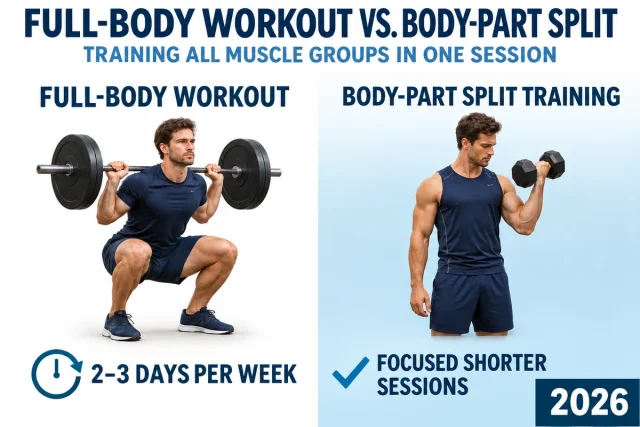
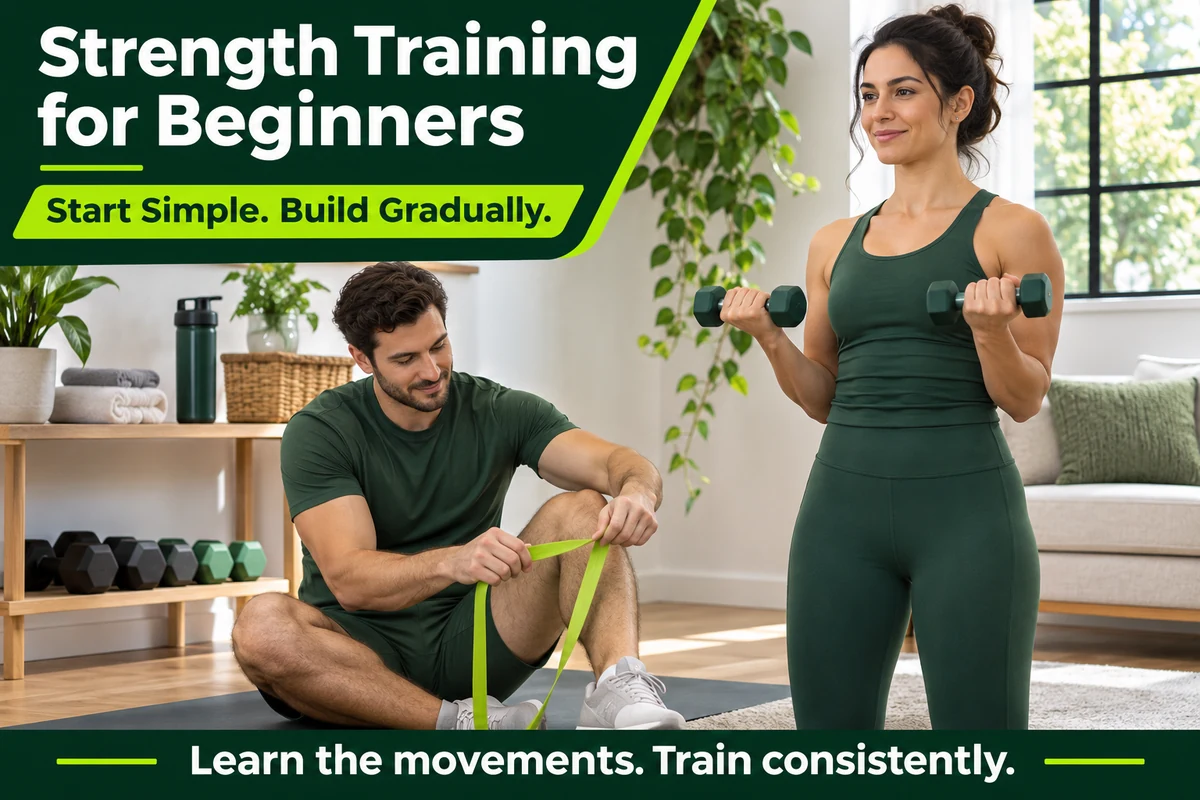
Start strength training with two manageable full body sessions each week on nonconsecutive days. Choose a small group of exercises that cover your major muscle groups. Learn comfortable controlled movements first and gradually increase the challenge as those movements become familiar.
The quick answer. A practical introduction is one working set of several suitable exercises after an easy warm up. For many movements 8 to 12 controlled repetitions can be a useful starting range. Use an easier version or less resistance if you cannot maintain control. Rest enough between exercises to repeat the movement well.
You can begin with machines or bands or body weight or light weights. You do not need to test your maximum strength or push every set until you cannot continue. The example program below is a starting framework for healthy adults rather than an individualized prescription.
This guide makes strength training for beginners easier to organize. It explains the basic terms and helps you choose exercises and resistance. You will also find a sample session and weekly schedule with practical progression examples and solutions for common problems at home and in the gym.
What strength training actually means
Strength training asks your muscles to work against resistance. The resistance can be a machine or a dumbbell or an elastic band. It can also be your own body weight during a movement such as standing from a chair or performing an appropriate push up.
You are learning movements as well as training muscles
A new lifter has two tasks. One is to practice how an exercise works. The other is to make that exercise challenging enough to train the muscles. Those tasks develop together. Choosing a difficult load before you understand the movement can make both tasks harder.
For your first sessions success can mean setting up correctly and repeating a few exercises with better control. You do not need to leave exhausted. Keep enough attention available to notice your position and breathing and what the equipment is doing.
Strength work supports everyday ability
The National Institute on Aging exercise guidance describes how strengthening can support activities such as standing from a chair and carrying groceries. These are useful reasons to train even when appearance or lifting a large weight is not your main goal.
Choose one practical goal that matters to you. It might be making ordinary lifting feel more manageable or becoming comfortable using gym equipment. A specific reason can help you evaluate your routine without expecting a dramatic physical transformation in a few weeks.
Build the routine around consistency
The 2026 American College of Sports Medicine guidance emphasizes regular participation and adapting the program to the person. Its evidence review supports several forms of resistance training rather than requiring one particular tool. For a beginner that means you can choose a setting you can realistically use.
The same guidance does not make complex training methods a prerequisite for ordinary healthy adults. You can begin without elaborate exercise rotations or a program that changes every day. First establish a routine that lets you practice the main movements consistently.
Make the first plan simple enough to repeat and clear enough to record. You can refine it after you have actual experience with the exercises.
Start with two appointments
Monday and Thursday are one possible pairing. Tuesday and Friday work too. Choose days that leave recovery space and fit your ordinary week. Include time for travel and setup if you train at a gym. A short nearby workout may be more repeatable than a longer plan that requires a difficult journey.
Keep the first exercise list stable
Repeat familiar movements long enough to learn what improves. If you change every exercise each session you lose useful comparisons. You can still make substitutions for comfort or access. Record those changes so you know whether the new version is actually comparable.
Understand the terms before following a program
Training language can make a simple routine look more complicated than it is. You only need a few terms to read the sample session in this guide. Learn what each number describes before trying to optimize it.
| Term | Meaning | Example |
|---|---|---|
| Repetition | One complete movement | Standing up and sitting down once |
| Set | A group of repetitions before a rest | Eight controlled repetitions |
| Resistance or load | What makes the exercise challenging | A dumbbell or a band or your body weight |
| Rest interval | The pause between sets or exercises | Time to recover enough for controlled movement |
| Progression | A planned increase in training demand | Adding a repetition while keeping control |
| Exercise variation | A different version of a movement | A wall push up instead of a floor push up |
Three sets of ten repetitions means ten movements followed by a pause and then repeating that process twice more. It does not mean completing thirty rushed repetitions without stopping. The amount you perform should fit your ability rather than the attractiveness of the number on the page.
Choose between home training and the gym
The better setting is the one that gives you safe access to suitable resistance and a routine you can maintain. Each option has practical advantages. You do not need to declare one universally superior before beginning.
| Option | Useful feature | Practical limitation | First step |
|---|---|---|---|
| Body weight at home | Little setup and no gym journey | Some movements are too difficult or hard to scale | Choose comfortable supported versions |
| Resistance bands | Portable with several resistance options | Attachment and condition need checking | Follow the product setup instructions |
| Dumbbells | Flexible exercise choices | Technique and available weight increments matter | Learn a few suitable movements |
| Gym machines | Guided movement and adjustable settings | Equipment must fit and still needs correct setup | Ask for a machine orientation |
At a gym ask someone qualified to show you seat adjustments and stops and how to select the load. Write down the settings you use. At home inspect the space and equipment before training. Avoid relying on unstable furniture or an improvised band attachment.
What to ask at your first gym visit
Ask how to adjust each selected machine and what to do if a repetition becomes too difficult. You can also ask which comparable exercise to use when a station is occupied. Those details make an orientation more useful than a quick tour of every machine.
What you need for a basic home setup
Begin with a clear floor area and stable support where appropriate. Comfortable clothing and footwear should allow movement without slipping. Additional equipment should solve a specific gap in your routine. You do not need a full rack of weights before learning the first few exercises.
Pick exercises that cover the whole body
Use movement categories to avoid repeatedly training only the areas you already enjoy. A basic session can include a knee dominant movement and a hip movement alongside pushing and pulling. Add suitable lower leg and trunk work as appropriate. Specific exercise choices should reflect comfort and access.
The following options are examples rather than equivalent replacements in every circumstance. Choose one suitable version for each role. If a movement is unfamiliar ask for instruction before adding significant resistance.
- A chair sit to stand or a suitable squat variation for a knee dominant movement.
- A glute bridge or an appropriately coached hip hinge for hip extension.
- A wall push up or a suitable chest press for pushing.
- A securely set up band row or a seated machine row for pulling.
- A supported calf raise for lower leg work.
- A comfortable trunk control exercise suited to your ability.
This framework keeps the first session understandable. It does not require that every reader perform every option immediately. Build coverage of the major muscle groups with appropriate exercise choices rather than forcing a movement that causes pain.
Beginner friendly standing options
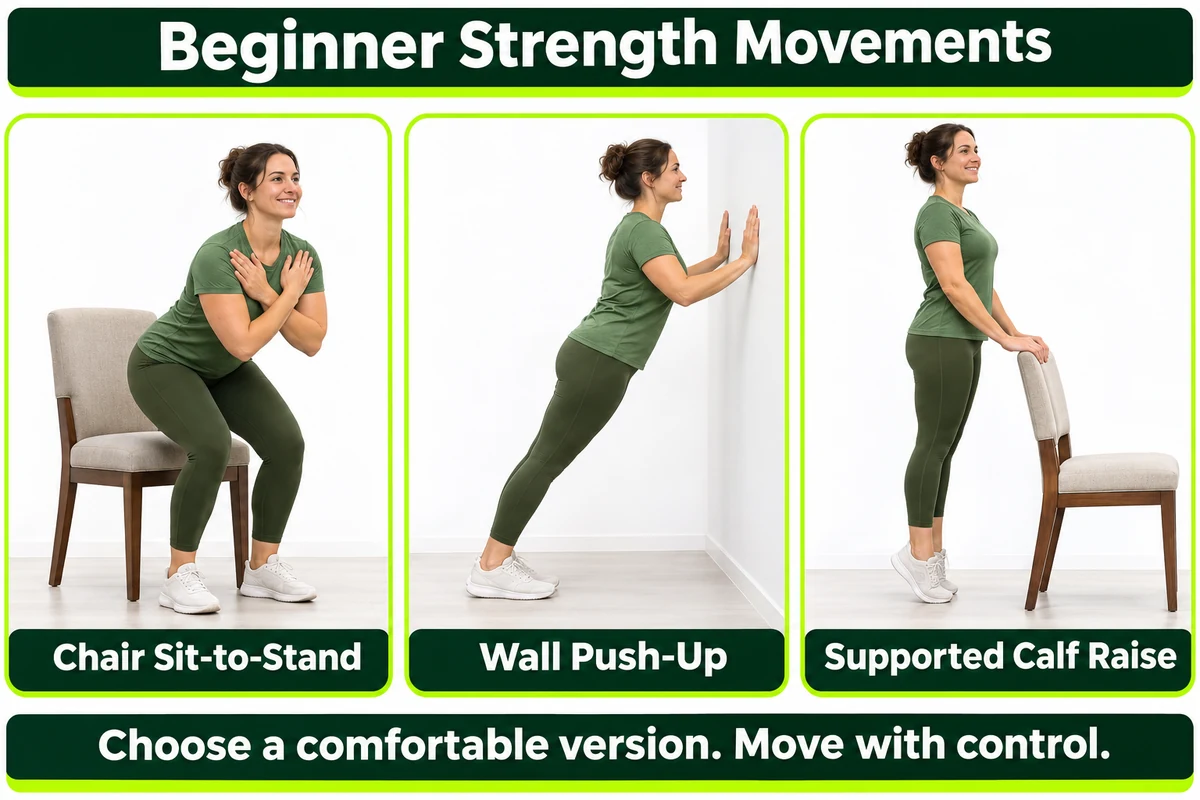
The NHS strength exercise guide illustrates movements including sit to stand and wall press ups and calf raises. These can be useful starting choices for someone who prefers standing exercises. A support needs to be stable and the movement should fit your current ability.
Pulling needs a practical setup
A wall push up is easy to arrange at home but a pulling exercise can require equipment. Do not replace pulling with more pushing simply because the setup is inconvenient. A suitable band or a gym row machine can fill that role. Learn its attachment or adjustment before the session.
Floor exercises are optional choices
A glute bridge can be convenient when getting down to the floor and standing up are comfortable. The NASM floor bridge exercise guide describes this hip extension movement. If floor access is difficult choose a suitable alternative with help rather than turning the transition into the hardest part of the workout.
A simple first strength training session
The table below is an educational starting template for a healthy adult who can perform the selected versions comfortably. It is not a rehabilitation plan. Treat the repetitions as adjustable practice targets. Begin with less if learning the setup or movement takes more time.
| Exercise option | Initial working sets | Practice target | Main checkpoint |
|---|---|---|---|
| Chair sit to stand | 1 | 8 to 12 repetitions | Stand and return without dropping into the chair |
| Wall push up | 1 | 8 to 12 repetitions | Keep the body controlled |
| Band or machine row | 1 | 8 to 12 repetitions | Avoid swinging to move the resistance |
| Glute bridge if suitable | 1 | 8 to 12 repetitions | Use a comfortable controlled movement |
| Supported calf raise | 1 | 8 to 12 repetitions | Use steady support and controlled lowering |
| Suitable trunk control exercise | 1 | A few slow controlled repetitions | Keep breathing and stop before losing position |
There is no prize for completing the table unchanged. If one option is not suitable substitute it with instruction. You can also practice fewer exercises at first while learning. Over time your program should cover the major muscle groups rather than remaining a random collection of comfortable movements.
How this relates to general recommendations
The CDC adult activity guidance recommends muscle strengthening on at least two days weekly. It describes 8 to 12 repetitions as a set and notes that one set can be effective while more sets can offer additional benefits. Your introduction to the movements can be easier before you build toward more challenging work.
Give the session enough time without rushing
Allow a practical appointment that includes setup and rest. Some beginners may fit this into roughly 20 to 35 minutes while others need longer to learn. That time estimate is organizational rather than a required exercise dose. Do not race through the workout to match it.
Choose a weight or variation that fits
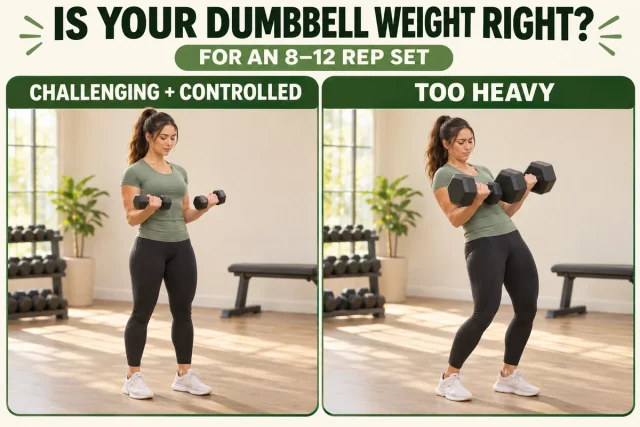
There is no universally correct starting dumbbell weight. An appropriate load for a leg exercise can be much too heavy for a smaller upper body movement. Your first session should help identify manageable resistance rather than prove how strong you already are.
Use a controlled trial set
Try a light load or an easier variation. Notice whether you can repeat the movement without jerking or changing position dramatically. Near the end the exercise may feel challenging but you should still be able to complete the movement deliberately. If you lose control reduce the load or stop the set.
Leave a little capacity while learning
A useful early practice cue is to finish feeling that a few more good repetitions might have been possible. You do not have to estimate that precisely. The point is to avoid forcing an uncontrolled final repetition during the learning stage.
As you gain familiarity the work should become meaningfully challenging. Keeping every set effortless forever is different from starting cautiously. Build the challenge through a manageable progression instead of jumping straight to maximum effort.
Body weight exercises can also be too heavy
A floor push up asks you to move a substantial portion of your body weight. If it is too difficult use a wall or another appropriate stable elevated surface. An exercise performed without a dumbbell is not automatically easier than one using a light external load.
Warm up and use controlled technique
Spend a few minutes moving easily before lifting. The Mayo Clinic guide to weight training technique recommends a 5 to 10 minute warm up. It also emphasizes controlled movement and breathing rather than holding your breath. Practice an easy version of the planned exercise before the working set.
Use rest to preserve movement quality
Pause until you can begin the next set or exercise with steady breathing and control. One to two minutes can be a useful starting pause for this simple routine but you may need longer. If reducing rest makes technique deteriorate then the shorter break is not helping your current goal.
Understand the setup before adding resistance
Check the chair position or machine seat or band attachment before beginning. Make sure you know how the movement ends. Setting a weight down safely is part of the exercise. Do not focus only on the lifting portion and then lose control when returning equipment.
Know when to stop. Stop an exercise that produces sharp pain or unusual symptoms. Chest pain or pressure and fainting and severe unusual breathlessness require stopping and urgent medical help when severe or persistent. Do not use a warm up to test whether concerning symptoms can be ignored.
The NIDDK activity guidance discusses starting gradually and recognizing warning symptoms. Existing conditions or injuries may require a plan adapted by your health professional.
Organize a beginner training week
Two full body sessions leave several opportunities for appropriate aerobic activity and recovery. The example below focuses on arranging strength work. It does not specify enough aerobic minutes to represent a complete weekly activity plan.
| Day | Planned activity | Purpose |
|---|---|---|
| Monday | Introductory full body strength session | Practice familiar movements |
| Tuesday | Suitable walking or other aerobic activity | Keep effort compatible with recovery |
| Wednesday | No structured workout or easy movement | Allow flexibility |
| Thursday | Full body strength session | Repeat and record the same exercise versions |
| Friday | Suitable aerobic activity if comfortable | Build the wider activity routine |
| Saturday | Optional activity suited to your capacity | Choose manageable movement |
| Sunday | No structured workout | Review and prepare for the next week |
The weekday names are flexible. Preserve a recovery gap between demanding sessions for the same muscles. If you miss Monday do not automatically schedule difficult full body workouts on Tuesday and Wednesday to restore the count.
Progress without changing everything at once
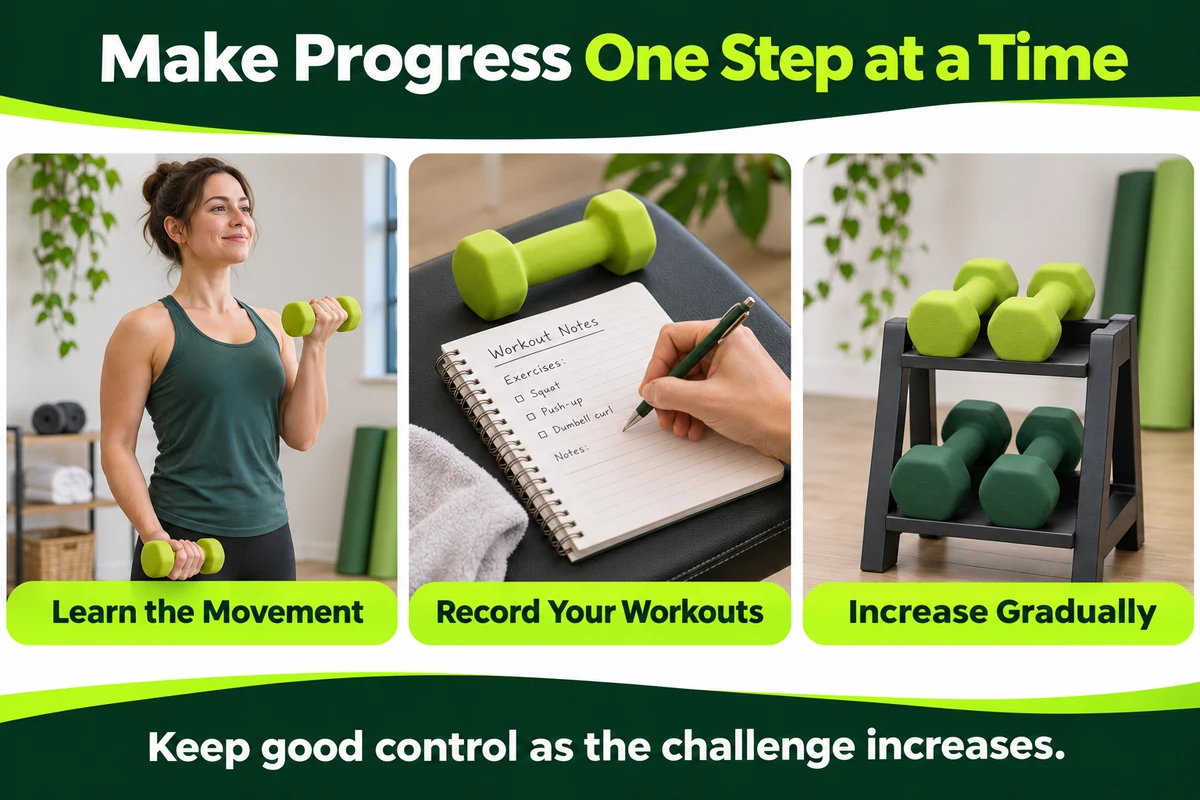
Progressive training means increasing the challenge as your ability develops. You can do that through repetitions or resistance or sets. You do not need to increase all three together. A clear change is easier to evaluate than a completely new routine.
Use the following sequence after the exercises feel familiar. It is a practical tracking method rather than a universal rule. Keep the same standards for movement quality so a higher number actually represents progress.
- Choose a repetition range for an exercise such as 8 to 12.
- Record the resistance or exercise version you used.
- Add a repetition when the current amount feels controlled and manageable.
- When you repeatedly reach the upper end comfortably consider a small resistance increase.
- Allow the repetition count to fall toward the lower end with the new resistance.
- Return to the previous option if the change disrupts movement control.
For example you might perform a row with 8 controlled repetitions and later reach 12 with the same setup. A small load increase can then provide a new challenge. You do not have to increase at every workout or choose a larger step than the equipment allows you to control.
When to add a second set
Consider another set when the first set and the overall routine are manageable and recovery is good. Add it to selected exercises rather than doubling everything automatically. Extra sets should serve a goal and fit the available time instead of becoming a requirement for feeling productive.
When to repeat the same workload
A busy week or a less settled technique can justify keeping the dose unchanged. Repetition is part of learning. Do not interpret every session without a numerical increase as a plateau that requires a new program.
A flexible first month
Think in learning stages rather than expecting a visible transformation by a fixed date. Some people need longer with the initial setup. Others become comfortable sooner. The stages below describe what to review and do not require weekly increases.
| Stage | Main task | Useful outcome |
|---|---|---|
| First sessions | Learn setup and comfortable exercise versions | You know what each movement should look and feel like |
| Repeat the routine | Record repetitions and resistance | You can compare like with like |
| Make one small change | Add suitable repetitions or a modest load adjustment | You understand how the change affects effort |
| Review the whole week | Check adherence and recovery and time | The next plan matches your actual circumstances |
There is no automatic need to move from two sessions to three at the end of a month. If the current routine remains useful you can continue developing it. Increase frequency when it helps distribute appropriate training rather than because a calendar page changed.
Recovery and nutrition support the routine
Leave time between demanding sessions for the same muscles and notice how you feel during normal activities. Some muscle tenderness can follow unfamiliar work. Severe or worsening symptoms and pain that changes how you move should prompt adjustment and assessment when needed.
Do not use soreness as the training score
A session can be useful without making you sore. Chasing discomfort can lead you to add more work than you can manage. Equally soreness is not a precise measure of whether a muscle is ready. Consider function and movement quality alongside the recent workload.
Keep the basics realistic
Protect regular sleep and adequate meals. Include protein containing foods as part of a balanced diet and enough overall food for your circumstances. Supplements are optional. Do not use a purchase to postpone solving a routine that regularly crowds out sleep or meals.
Common problems and practical fixes
You cannot complete the target repetitions
Check whether the exercise version or resistance is too difficult. Use fewer controlled repetitions during early learning or choose an easier version. Do not turn the last movements into a different exercise just to finish the number.
You can easily exceed the target
If the movement is familiar and controlled consider a small increase in resistance or an appropriate variation. Keep a record so the change is deliberate. Adding several new exercises may make the session longer without addressing the easy movement.
The machine you need is occupied
Use a suitable alternative you already know or adjust the order if that is practical. A crowded gym is not the best place to improvise an unfamiliar heavy exercise. Ask for an alternative during your orientation and keep it in your notes.
You feel intimidated
Arrive with a short exercise list and a clear first station. Ask for help with a specific adjustment rather than trying to understand the whole room at once. A quieter training time can also make learning easier if it fits your schedule.
You only have a short appointment
Choose fewer appropriate exercises and maintain reasonable rest instead of rushing the entire session. A clear shorter version helps during busy days. Return to the usual program when time allows rather than treating one abbreviated session as a reason to stop.
Frequently asked questions about strength training for beginners
Can you build strength without a gym?
Yes. Suitable body weight exercises and bands and free weights can provide resistance. The important practical questions are whether the movements cover your needs and whether you can make them appropriately challenging over time.
Do beginners need barbells?
No. Barbells are one tool rather than a requirement. Machines or bands or dumbbells may be more convenient for your situation. Learn the equipment you choose before increasing the challenge.
Should women and men use completely different routines?
Exercise choices should reflect goals and ability and health rather than a rigid sex based template. Starting resistance can differ between individuals. That is a reason to adjust the load rather than assume one group needs an entirely different movement system.
Should you train to failure?
You do not need to make failure the goal of every set. During early learning stop before losing control. The appropriate challenge can increase with experience without requiring an uncontrolled final repetition.
Can older adults start strength training?
Yes. Age alone does not rule it out. Exercise selection and support and health circumstances matter. Someone with mobility limitations or a relevant medical condition may benefit from a more individualized introduction.
How soon will you see results?
There is no guaranteed schedule for appearance changes. Begin by tracking technique and attendance and controlled repetitions. These provide useful feedback while strength and other adaptations develop over time.
Make your first session concrete
Choose two suitable days and a small set of exercises. Learn the setup and begin with manageable resistance. Write down what you actually did and how it felt. That gives the next session a clear starting point.
You do not need to master every training method before beginning. Build a repeatable routine and make small changes when they are useful. Strength training becomes easier to understand when each session gives you information you can use next time.
Sources and editorial scope
The linked professional and public health sources support the general recommendations and technique principles. Exercise tables and progression stages are original educational examples rather than individualized prescriptions. This article does not claim personal testing or a medical assessment. Sources were checked on November 5 2026.