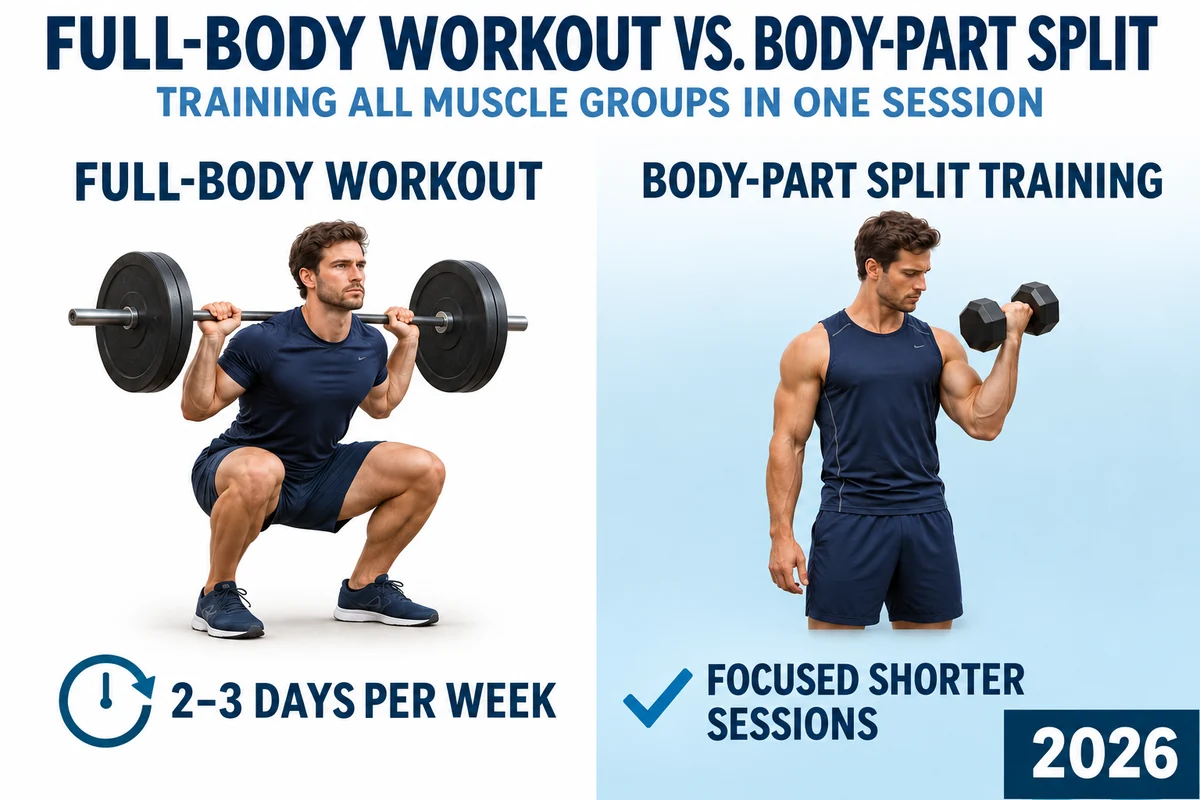
If you have just walked into a gym, or opened a workout app for the first time, you have probably run into this argument already: should you train your whole body every session, or split your week into “chest day,” “leg day,” and so on?
Both approaches work. But for most beginners, one of them is usually the easier and smarter place to start. Below is how the two compare, what the research actually says, and how to pick the one you will stick with.
The short answer: for most beginners, a full-body routine two to three days a week is the best starting point. It is simple, flexible, and gives you more practice with the basic lifts. A split routine becomes a better fit later, once you train more often or want more focused work on specific muscles.
What Is a Full-Body Workout?
A full-body workout trains all the major muscle groups in a single session. A typical session includes:
- A squat or lunge variation for the legs
- A push, such as a push-up or bench press
- A pull, such as a row or lat pulldown
- A hinge, such as a deadlift or hip thrust
- Some core work
You usually train two or three non-consecutive days a week, for example Monday, Wednesday, and Friday, with rest days in between.
What Is a Split Workout?
A split workout divides your training across the week so each session focuses on certain muscle groups. Common splits include:
- Upper/lower: upper body one day, lower body the next (usually four days a week)
- Push/pull/legs: pushing muscles, pulling muscles, and legs on separate days (three to six days a week)
- Body-part split: one or two muscle groups per day, such as chest and triceps (often five days a week)
Because each session covers fewer muscles, you can do more exercises and sets for each one in that session.
Full-Body vs. Split: Side-by-Side Comparison
| Training factor | Full-Body | Split |
|---|---|---|
| Typical days per week | 2–3 | 4–6 |
| Times each muscle is trained per week | 2–3 | Often 1–2 |
| Session length | Moderate | Can be shorter per session, but more sessions |
| Skill practice on basic lifts | High | Lower |
| Flexibility if you miss a day | High | Lower (you may miss a whole muscle group) |
| Complexity | Simple | More planning |
| Best for | Beginners, busy schedules | Intermediate lifters, people training 4+ days |
What Does the Research Say?
A 2024 review by Ramos-Campo and colleagues compared full-body and split routines across 14 studies involving 392 adults. When training volume was matched, the review found no statistically significant differences in strength gains or muscle growth. Both routines can work, and the format you choose can depend on how you prefer to spread your training across the week (Ramos-Campo et al., 2024).
A separate review found that how often you train each muscle appears to have little effect on muscle growth when total training volume is similar (Grgic et al., 2019). For a beginner with two or three days available, full-body sessions offer a simple way to practice the main lifts regularly. If four shorter sessions fit your schedule better, an upper/lower split can cover the same muscle groups across the week.
Why Full-Body Usually Works Better for Beginners
1. More practice on the basic movements
Squats, presses, rows, and hinges are skills. Doing them three times a week gives you more chances to learn good form than doing each once a week.
2. It is simple
There is no complicated rotation to remember. You do roughly the same workout each time, and you add weight or reps over time.
3. Missing a session is not a disaster
Miss a Wednesday full-body session and you have still trained everything on Monday and Friday. Miss “leg day” in a split and that muscle group may go a full week untrained.
4. It fits a busy life
If you can only get to the gym two days a week, a full-body routine still covers everything. A split needs more days to be balanced.
5. Rest days are built in
Training every other day gives your muscles time to recover between sessions, which is useful when your body is still adapting to exercise.
When a Split Might Be the Better Choice
Full-body is not automatically right for everyone. A split can make sense if:
- You genuinely enjoy training four or more days a week. Splits make that frequency manageable without every session being exhausting.
- You find full-body sessions too long or too tiring. Shorter, focused sessions can feel better for some people.
- You have a specific goal. If you want extra work on a particular area, a split lets you spend more time on it.
- You are already past the beginner stage. As you progress, you may need more weekly work per muscle than a few full-body sessions comfortably allow.
The key point from the research: a beginner who loves an upper/lower split and sticks with it will likely do better than one who forces a full-body plan they dread.
Sample Beginner Plans
These are general templates, not personalized prescriptions. Start with weights that feel manageable, and prioritize good form over heavy loads.
Option A: 3-Day Full-Body Plan (Mon / Wed / Fri)
Do 2–3 sets of 8–12 reps for each exercise, resting 60–90 seconds between sets.
| Movement | Example exercise |
|---|---|
| Squat pattern | Goblet squat |
| Horizontal push | Push-up or dumbbell bench press |
| Horizontal pull | Seated cable row or dumbbell row |
| Hip hinge | Romanian deadlift or hip thrust |
| Vertical push or pull | Overhead press or lat pulldown |
| Core | Plank or dead bug |
You can alternate two versions of this session (A and B) with slightly different exercises to keep things interesting.
Option B: 4-Day Upper/Lower Plan
| Day | Focus |
|---|---|
| Monday | Upper body |
| Tuesday | Lower body |
| Wednesday | Rest |
| Thursday | Upper body |
| Friday | Lower body |
| Weekend | Rest or light activity |
This schedule gives each muscle group two training days per week and lets you focus each session on either upper- or lower-body exercises.
How to Choose: A Quick Decision Guide
| Your situation | What to try |
|---|---|
| Can train 2–3 days per week? | Go full-body. |
| Can train 4 days per week and want longer-term variety? | Try upper/lower. |
| Brand new to lifting and unsure about form? | Full-body, with frequent practice of the basics. |
| Hate your current plan? | Switch. Consistency beats the “perfect” program. |
Common Beginner Mistakes
- Switching programs every few weeks. Give any plan at least 8 to 12 weeks before judging it.
- Doing too much too soon. Start with fewer sets and build up gradually.
- Skipping progression. Gradually adding weight, reps, or sets is what drives results.
- Ignoring sleep and nutrition. Recovery and adequate protein support your progress.
- Copying an advanced lifter’s routine. What works for someone with years of training can be too much for a newcomer.
Frequently Asked Questions
Can beginners do a split routine?
Yes. A split can work for beginners, especially upper/lower or push/pull/legs at a manageable volume. It is simply less necessary at the start, and it requires more days in the gym.
How many days a week should a beginner work out?
Most beginner guidance centers on two to three strength sessions per week. Add more only if your schedule and recovery allow it.
Is a full-body workout good for building muscle?
Yes. Training each muscle two or three times per week with enough weekly effort is an effective way to build muscle, particularly for newer lifters.
Is a full-body workout good for fat loss?
Full-body sessions use a lot of muscle mass and burn a meaningful number of calories, but fat loss depends mainly on your overall eating and activity habits, not on your split.
When should I switch from full-body to a split?
Consider it when progress stalls despite good effort and recovery, when your sessions feel too long to fit everything in, or when you want to train more days per week.
The Bottom Line
For most beginners, a full-body routine two to three days a week is the simplest, most flexible way to start: you practice the key lifts often, recover between sessions, and do not fall behind if you miss a day. Splits are a great option too, especially when you want to train more often or focus on specific areas.
The best program is the one you can follow consistently for months. Start simple, keep showing up, and adjust as you learn what your body responds to.
Disclaimer: This article is for general information and is not medical advice. If you have an injury, a health condition, or are returning after a long break, check with a doctor or qualified trainer before starting a new program.