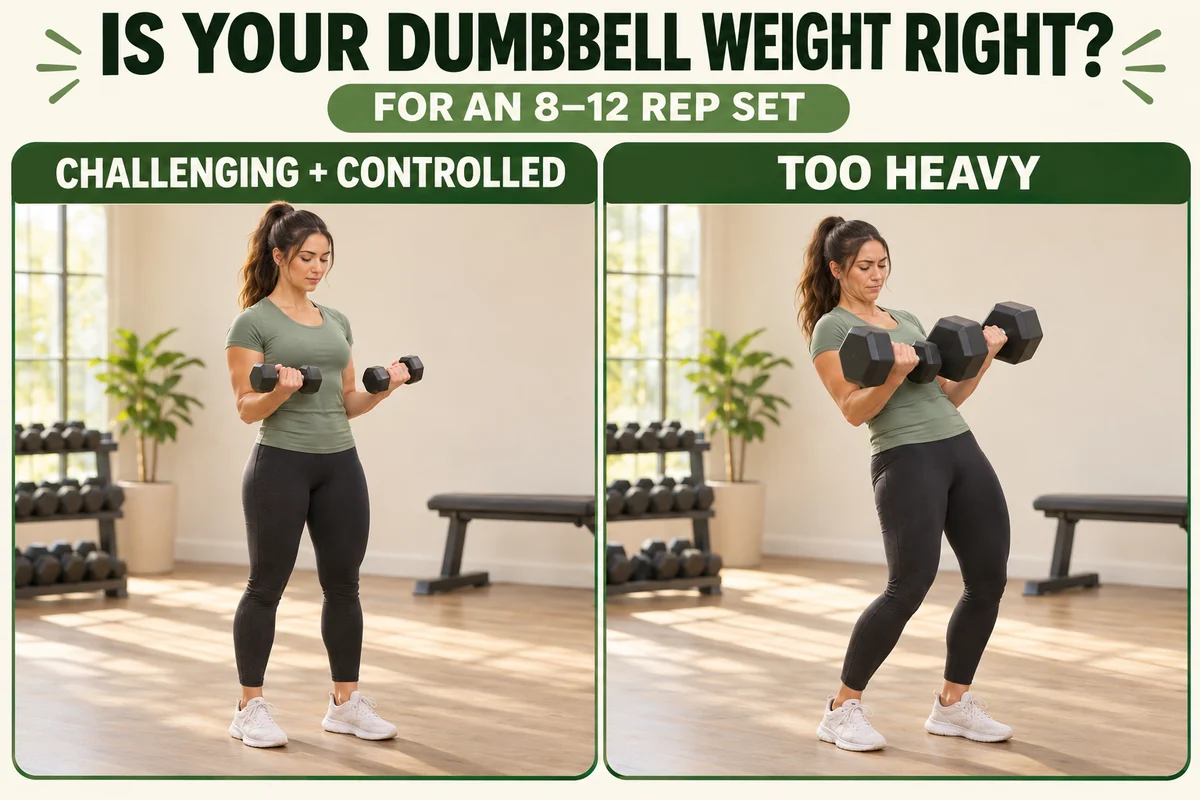
The dumbbell you can row comfortably might be too heavy to raise out to the side. That is normal. The right weight depends on the exercise, the number of reps you plan to do, and how well you can control each rep.
Quick answer
For an exercise with an 8–12 rep target, start with a weight you can lift for at least eight controlled reps. End the set when you think you have two or three good reps left, or when you reach 12.
| What you notice | What to do |
|---|---|
| Your form breaks down before 8 reps. | Go lighter. |
| You finish 8–12 controlled reps with 2–3 good reps left. | Keep the same weight. |
| You reach 12 and could easily do several more reps. | Try the smallest increase next time. |
How to Test Your Starting Dumbbell Weight
Test one exercise at a time. For your first session, the goal is to find a repeatable starting point you can write down and use again.
- Pick a rep range. Use 8–12 reps for a row, squat or floor press as a practical starting range. For a light accessory exercise such as a lateral raise, you can use 12–15.
- Rehearse the movement. Do a few easy reps with no weight or a light dumbbell. Notice where you start and finish, and how it feels to lower the weight under control.
- Try a conservative weight. Use the same setup and movement on every rep. Stop when you estimate you have two or three good reps left, when you reach the top of your range, or when you can no longer keep the same form.
- Use the result to adjust. If you reach the bottom of your range with control and only a few good reps left, you have a workable starting weight. If you stop early, go lighter. If you had an easy set at the top of the range, try the next small increase after resting or in your next workout.
“Reps left” is an estimate. When you are new, use visible cues too. If you have to swing your body, cut the movement short, or let the weight drop on the way down, end the set and adjust the load. Mayo Clinic also recommends lowering the weight or the rep count when you cannot maintain good form. Mayo Clinic weight training guidance
How to Tell If a Dumbbell Is Too Light or Too Heavy
| What happens in an 8–12 rep set | What to do |
|---|---|
| You stop at six because the next rep would require swinging or shortening the movement. | Use a lighter dumbbell or an easier variation and retest. |
| You finish ten controlled reps and could probably do two more. | Keep this weight and build toward the top of the range. |
| You do 12 with steady form and could easily do several more. | Try the smallest available increase after a rest or at the next session. |
| You feel sharp pain during a rep. | Stop the exercise. If the pain persists or keeps returning, seek advice from a qualified health professional. |
Choose a Weight for Each Exercise
Test every new movement on its own. A dumbbell that works for your legs may be too heavy for a lift that asks your shoulders to control the weight with your arms held away from your body.
| Exercise | How to log the weight | What to watch on the last rep |
|---|---|---|
| Goblet squat | One dumbbell held at your chest | You can stand up steadily and squat to the same comfortable depth. |
| One-arm row | One dumbbell, reps recorded per side | Your torso stays steady as you lift and lower the weight. |
| Dumbbell floor press | Weight per hand and reps per set | You lower both dumbbells evenly and keep your wrists steady. |
| Lateral raise | Weight per hand and reps per set | You can raise the weights without swinging or shrugging to finish. |
Weight per hand matters. Two 10 lb dumbbells are 20 lb combined. Write “10 lb per hand” for a floor press and “one 10 lb dumbbell” for a goblet squat so your next session is easy to reproduce.
When Should You Increase Dumbbell Weight?
Build reps before increasing the load. If you do two sets in an 8–12 rep range, stay with the same weight until both sets reach 12 with steady form and a little effort left. Confirm that on another workout if the first time felt unusually easy. Then test the smallest increase and expect the rep count to drop toward eight.
Example · Dumbbell floor press
At 10 lb (about 4.5 kg) per hand, you log 10 and 9 reps in your first workout. Later you reach 12 and 12 without rushing the lowering phase. With 12.5 lb (about 5.7 kg) per hand, eight controlled reps may be a reasonable next starting point if you still have a couple of good reps left. If you can only manage six, return to 10 lb for your working sets.
What if the next dumbbell is too heavy?
Going from 5 lb to 10 lb doubles the weight. If that jump takes you below your target range, keep the lighter dumbbell and build toward a few more controlled reps, such as 13–15. If you have access to adjustable dumbbells with smaller increments, use those for the next step. Record what you did so you can compare the same movement next time.
Common Beginner Mistakes
- Testing every exercise after a hard workout. Fatigue changes what you can lift. Compare the same exercise at roughly the same point in your workout.
- Judging the weight by the first rep. A manageable first rep tells you little about whether the tenth will look the same.
- Increasing weight because a week has passed. Use your reps and form as the signal. Repeating a weight while making your sets steadier is useful progress.
Frequently Asked Questions
Are 5 lb dumbbells enough for beginners?
They can be enough for movements such as lateral raises or for learning a new exercise. Test the same pair separately for squats or rows. If those movements stay easy through your target reps, use a heavier weight for those exercises when available.
Should I use the same weight on both sides?
For a one-arm exercise, try the less confident side first. Use a weight it can control, then match that weight and number of reps on the other side.
What dumbbells should I buy if I can only afford one pair?
Choose a pair you can control on the most challenging exercise you plan to do regularly. For example, if your floor press needs a lighter load than your squat, buy the pair that fits the press and use bodyweight squats or a higher rep range for your legs. If you can try the weights in a shop or gym first, use the test above before buying.
The Bottom Line
Start with one exercise today. Write down the weight per dumbbell, how many clean reps you completed, and how many you think you had left. At your next workout, use those notes to decide whether to repeat the load, add a rep, or try the smallest increase.
Sample workout log: Floor press · 10 lb per hand · 10 reps, then 9 · about 2 reps left in the last set · repeat the weight next time.