How Often Should Beginners Work Out? A Simple Weekly Guide
Starting a workout routine is easier when you know what a manageable week looks like. You do not need to train every day or copy an experienced lifter. You need a starting point that fits your current fitness and leaves enough energy to come back.
The short answer. For many adult beginners two full body strength workouts on nonconsecutive days are a practical starting point. Add walking or another suitable aerobic activity during the week. Three planned workout appointments can work well too but there is no single ideal number for everyone.
Gradually work toward the general adult health target of at least 150 minutes of moderate intensity aerobic activity each week plus muscle strengthening on at least two days. You do not have to reach that target during your first week.
This guide explains how often beginners should work out and how to choose between two days and a fuller schedule. You will find example weeks and a simple strength session alongside practical rules for recovery and progression. The schedules are educational examples rather than individualized medical or rehabilitation programs.
Count the type of exercise as well as the days
Two people can both exercise four days a week and follow very different routines. One might take short walks. The other might complete demanding lifting sessions. The number of days tells you little without knowing the duration and effort of each session.
Strength training and aerobic exercise do different jobs
Strength training uses resistance to challenge your muscles. That resistance can come from your body weight or bands or weights. Aerobic exercise includes activities such as brisk walking and cycling that increase your breathing and heart rate over a period of time.
You can combine both on the same day. A strength session followed by a walk is still one training day. However your entire strength session does not automatically count toward your weekly aerobic minutes. Track the two categories separately so your plan reflects what you actually do.
Everyday movement also belongs in your week
Walking to an errand and getting up between long periods of sitting can make your day more active. A gentle stroll may not reach moderate intensity though. Keep the distinction clear between moving more throughout the day and accumulating aerobic activity at a particular effort.
Choose a schedule you can repeat during an ordinary busy week. A plan that fits your life gives you more opportunities to practice than one you regularly have to abandon.
What official exercise guidelines recommend
The Centers for Disease Control and Prevention recommends at least 150 minutes of moderate intensity aerobic activity each week for adults. An equivalent amount of vigorous activity is another option. Adults also need muscle strengthening activity on at least two days that works the major muscle groups.
These are public health goals rather than a mandatory first week assignment. The Physical Activity Guidelines questions and answers explains that activity can be accumulated in shorter bouts. You do not need an uninterrupted half hour before a walk becomes worth doing.
A gym membership is optional. Your weekly activity might include home workouts and outdoor walks. The useful distinction is between your starting dose and the longer term target. A smaller beginning can help you learn what you tolerate before adding more time or effort.
Who this guide is for. The examples mainly address adults beginning general fitness. Pregnancy and injuries and health conditions can require different choices. Older adults may also need specific balance work. Children have different activity recommendations.
Should you start with two or three or four days?
Begin with the appointments you can realistically protect. Think about your usual workweek rather than a particularly quiet week. Include travel time and family responsibilities. If your plan repeatedly forces you to choose between exercise and adequate sleep then the schedule needs adjustment.
| Planned sessions | Example structure | Useful when | Watch for |
|---|---|---|---|
| Two | Two full body strength sessions with walking elsewhere in the week | Your time is limited or the habit is new | Forgetting aerobic activity outside the sessions |
| Three | Two strength sessions and one aerobic session | You want a simple mix of activities | Assuming three short sessions meet every guideline |
| Four | Two strength sessions and two aerobic sessions | You prefer shorter separate appointments | Making every session demanding |
| Five or more | A mixture of training and easy movement | Frequent activity fits your routine and recovery | Confusing daily movement with daily hard training |
When two planned sessions make sense
If your schedule is crowded then two clear appointments can be easier to maintain. Monday and Thursday are one possible pairing. Prepare your clothes and decide where you will train. Add short walks around existing commitments rather than relying on a third long gym visit.
When a third appointment helps
A third session can create dedicated time for aerobic exercise without extending your lifting workouts. It is an organizational option rather than a requirement. If keeping that extra appointment causes you to miss the two sessions you value most then simplify the week first.
A simple first week for a less active beginner
This sample week introduces a modest amount of structured activity. The times are suggestions rather than minimums you must complete. Shorten them if needed or split a walk into smaller outings. Someone who currently does very little may need an even smaller starting dose.
| Day | Suggested activity | Approximate time | Main purpose |
|---|---|---|---|
| Monday | Easy full body strength practice | 15 to 20 minutes | Learn a few movements |
| Tuesday | Comfortable or moderate walking as tolerated | 10 to 15 minutes | Find a manageable pace |
| Wednesday | No scheduled workout | Optional easy movement | Check recovery |
| Thursday | Easy full body strength practice | 15 to 20 minutes | Repeat familiar movements |
| Friday | Walking as tolerated | 10 to 15 minutes | Build a repeatable appointment |
| Saturday | Walking or comfortable stationary cycling | 10 to 20 minutes | Try an enjoyable activity |
| Sunday | Rest or easy movement | Based on how you feel | Prepare for the next week |
The planned aerobic activity adds up to 30 to 50 minutes. Some of it might be light rather than moderate. This is a starting example rather than a complete guideline meeting week. Its purpose is to give you something manageable to evaluate and gradually develop.
What a week with 150 aerobic minutes can look like
Once you can comfortably tolerate more activity you can build toward a different distribution. The following example includes 150 minutes of moderate intensity aerobic activity alongside two strength sessions. It may take longer than a month to reach this schedule. Your response matters more than the date.
| Day | Activity | Moderate aerobic minutes |
|---|---|---|
| Monday | Strength followed by suitable brisk walking | 20 |
| Tuesday | Brisk walking | 30 |
| Wednesday | No scheduled workout | 0 in this example |
| Thursday | Strength followed by suitable brisk walking | 20 |
| Friday | Moderate cycling or walking | 30 |
| Saturday | Moderate walking | 30 |
| Sunday | Moderate walking | 20 |
The calculation is 20 plus 30 plus 20 plus 30 plus 30 plus 20 for a total of 150 minutes. You can divide a 30 minute day into three 10 minute walks. Whether the minutes count as moderate depends on your actual effort rather than the activity label.
This example also shows why the phrase workout days can mislead. There are two strength days but several walking days. You can build an active week without treating every outing as a hard workout or traveling to a fitness facility six times.
How long should a beginner strength workout last?
A short organized session gives you room to learn without rushing. Start with a few minutes of easy movement and comfortable practice versions of your exercises. Then complete a small selection of movements with enough rest to stay in control. The clock should not dictate poor technique.
A practical full body session template
The following movements illustrate common exercise patterns. They are options rather than a universal prescription. Choose versions you can perform comfortably and ask a qualified trainer for help when technique is unfamiliar. Do not increase resistance to compensate for uncertainty about the movement.
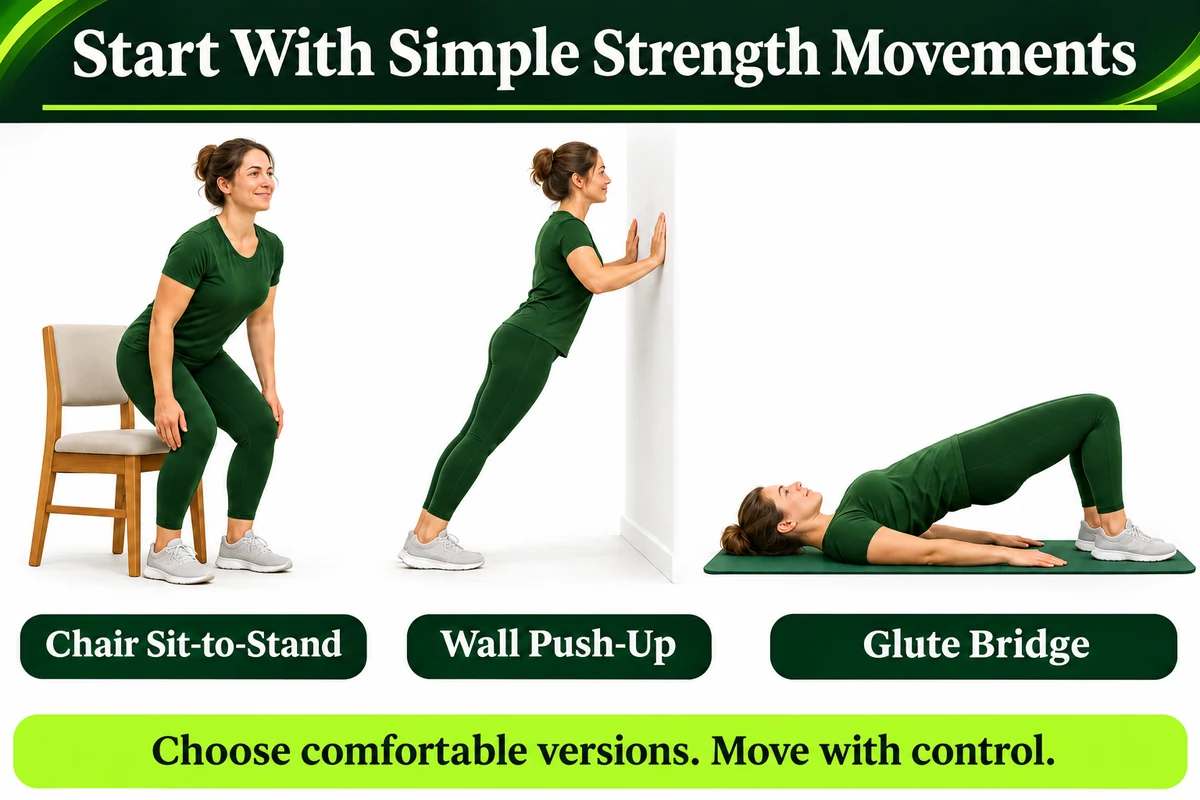
- Sit down and stand up from a stable chair to practice a squat pattern.
- Use a wall push up or a suitable stable elevated surface for a pushing movement.
- Perform a row using an appropriate resistance band and a secure attachment.
- Try a glute bridge if getting down to the floor and standing up again are comfortable.
- Use a manageable trunk control exercise such as a supported hands and knees limb lift.
You do not have to master every option during your first session. Adjust the range of motion or resistance as needed. Over time your plan should address the major muscle groups rather than repeatedly training only the movements that already feel easiest.
Choose repetitions you can control
One set of each selected exercise can be a manageable introduction. A general range of 8 to 12 repetitions is common in strength guidance but it does not fit every movement or person. During early practice leave some capacity rather than forcing an awkward final repetition.
Take enough rest to begin the next set with controlled breathing and stable movement. A minute or two might work for an easy session but longer can be appropriate. Write down the exercise version and resistance so you have a useful comparison next time.
How hard should beginners work out?
The same walking speed can feel very different to two people. A treadmill setting cannot tell you whether the effort suits your current fitness. Pay attention to breathing and movement quality rather than trying to match someone else’s pace or weights.
Use the talk test during aerobic exercise
The CDC explanation of activity intensity describes moderate activity as an effort at which you can talk but cannot sing. During vigorous activity you can say only a few words before pausing for breath. This is a useful rough check during activities such as walking or cycling.
You do not need to become breathless to make a session worthwhile. Slow down or pause if the effort is beyond what you can manage. Light activity can be an appropriate beginning before you build the ability to sustain moderate activity for longer.
Use control as your strength training checkpoint
If you need to jerk through repetitions or change your position dramatically then reduce the difficulty. Choose an exercise version that lets you move steadily and breathe normally. Muscular effort is different from sharp pain. Exhaustion is not a useful requirement for a first workout.
How much rest do beginners need?
For a simple full body strength routine putting a day between sessions is a practical starting arrangement. It gives you an opportunity to assess how you respond before repeating the work. It does not guarantee that everyone has recovered after a fixed number of hours.
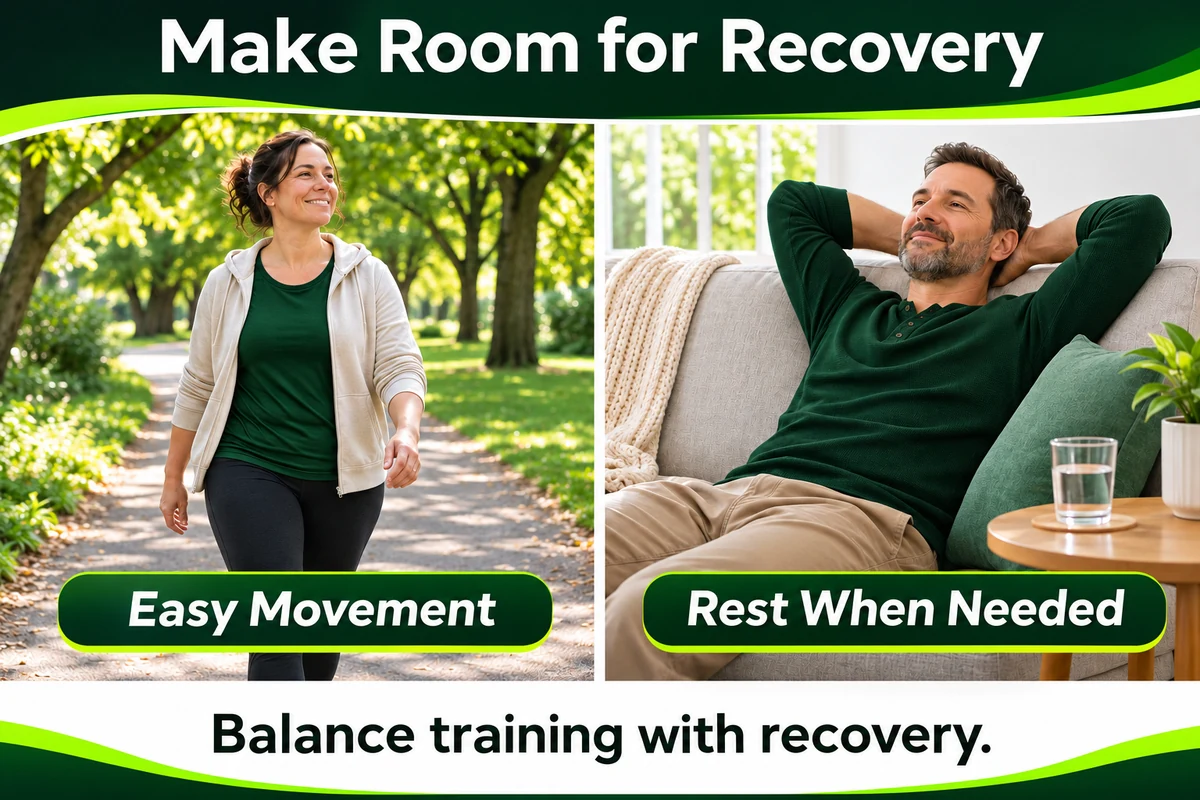
Rest days can include easy movement
If you feel comfortable then an easy walk or normal household movement can fit between strength sessions. Keep it easy rather than turning recovery into another demanding workout. If you are ill or unusually exhausted then rest and reassess what is appropriate for your situation.
Soreness is not your progress score
Unfamiliar exercise can leave muscles feeling uncomfortable afterward. A workout can still be productive without soreness. If discomfort changes how you walk or interferes with ordinary activities then do not push through simply to maintain a streak. Adjust the plan and seek advice for persistent or unusual pain.
Stop for warning symptoms. Chest pain or pressure and fainting and severe unusual shortness of breath require stopping activity. Seek urgent medical help when symptoms are severe or persist. Sharp pain or recurring dizziness also needs assessment before continuing.
The Office on Women’s Health activity safety guidance advises stopping for symptoms such as chest pain and trouble breathing and feeling faint.
Build your routine through flexible stages
There is no single progression rate that works for every beginner. Someone may need several weeks to establish two appointments. Another person may tolerate additional walking sooner. Treat the following stages as review points rather than a calendar you must follow.
Before increasing the plan look at what you actually completed. Scheduled workouts are different from completed workouts. Your record helps reveal whether the limiting factor is time or effort or recovery. Make the next decision from that information rather than from enthusiasm alone.
- Establish your initial strength appointments and learn manageable versions of a few exercises.
- Add a little time to one aerobic session if the current amount feels sustainable.
- Repeat the new amount long enough to understand its effect on fatigue and scheduling.
- Add a set to selected strength exercises or a small resistance increase when movement is consistent.
- Consider another appointment only when it serves your goal and fits your recovery.
Avoid increasing days and duration and resistance all at once. Changing one element makes your response easier to understand. If performance deteriorates or new pain appears then reduce the dose and investigate. You do not need an advanced routine by a particular week.
Adjust your weekly plan to your goal
For general health and fitness
Build a repeatable combination of aerobic activity and strength work. Choose activities based on access and enjoyment and comfort. Two activities you like can be easier to maintain than an elaborate rotation you dislike. Keep the routine simple enough that preparing for it does not become a barrier.
For building muscle
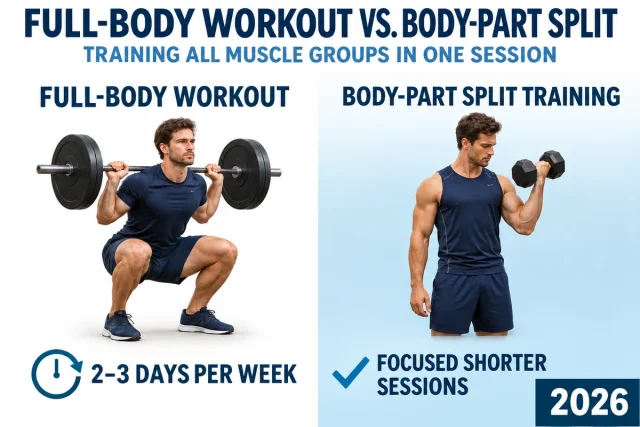
Two full body sessions provide a practical way to begin organizing resistance training. Track exercises and sets and resistance over time. Gym visits alone do not guarantee muscle growth. A beginner does not need a six day body part split to start learning movements and developing a training habit.
If sessions eventually become too long then spreading the work across more days may help. That decision should serve manageable training volume and recovery. Adding another day simply because an experienced athlete uses one does not explain what your own program needs.
For weight management
Use activity to support fitness and consistency alongside appropriate eating habits. Do not double your workouts whenever the scale stalls. Body weight responds to multiple factors and cannot be predicted from workout frequency alone. Notice walking capacity and strength practice and adherence as well as changes in weight.
Solutions for common beginner scheduling problems
You only have ten minutes
Give those minutes a clear purpose. They could be a short walk or a limited selection of familiar strength movements. Do not cram a full session into the time by removing every rest period. Keep a shorter version of your routine available for unusually busy days.
You missed a workout
Resume at the next suitable opportunity while allowing recovery between demanding sessions. Missing Monday does not require doubling Thursday’s training. You could move the session to Tuesday if that works with the rest of the week. A useful plan allows small changes without turning them into a failure.
Your available days are back to back
One option is strength on one day and suitable aerobic activity on the next. That can be simpler than repeating two demanding full body sessions. Add short activity elsewhere when possible. A qualified trainer can help adjust workload if your schedule requires a more specific arrangement.
You exercise at home without equipment
Use stable surfaces and clear enough space to move comfortably. Do not lean on furniture that can slide. Resistance bands need reliable attachment points. Some pulling exercises are easier with suitable equipment. Choose a safe setup rather than improvising an uncertain anchor to complete a checklist.
You keep getting bored
Keep your main strength exercises consistent long enough to learn them. Change smaller details such as your walking route or choice of aerobic activity. Replacing every exercise each week makes progress harder to assess. You can have variety without rebuilding the entire routine every session.
Use a simple weekly review before adding more
You do not need a paid app or fitness watch to evaluate your schedule. A short note can record the activity and duration and exercise version and how you felt afterward. Keep tracking brief enough that it supports exercise rather than becoming another obstacle.
At the end of the week review the following questions. Use concrete observations when possible. A note that you could not complete familiar repetitions is more useful than a vague judgment that you were not motivated enough. Look for patterns across sessions rather than overreacting to one difficult day.
- Did you complete the appointments without repeatedly disrupting essential responsibilities?
- Could you maintain controlled movement through most of each session?
- Did you recover enough for ordinary activities and the next workout?
- Can you add a little activity without sacrificing sleep or necessary rest?
- Would consistency help more right now than a larger training dose?
If the answers support progression then make one small change. If they are mixed then repeat or simplify the week. A short regular review gives you better direction than repeatedly switching programs after seeing a new workout online.
Frequently asked questions
Is working out twice a week enough for beginners?
Two strength sessions can be a useful start. Your overall activity still includes what you do outside those sessions. Do not assume that two short workouts meet every health recommendation. Include aerobic activity and build toward a weekly amount you can sustain.
Can beginners exercise every day?
Easy movement may fit into every day if it suits your health and ability. Hard daily sessions are not required. Distinguish a comfortable walk from a demanding resistance workout. If you enjoy a daily habit then keep some days deliberately easy and allow recovery.
Should beginners lift weights three times a week?
They do not have to. Two nonconsecutive full body sessions are simpler for many people starting out. A third can be considered when the goal and workload and recovery justify it. Review total training rather than automatically adding another copy of an already tiring session.
When should you increase resistance?
Consider a small increase after you can repeatedly complete the planned work with control and without pain or obvious compensation. A lack of soreness is not a reason to add weight. If the increase disrupts technique then return to the previous load or use a smaller step.
Does walking replace strength training?
Walking can form the aerobic foundation of a routine. It does not automatically provide balanced resistance work for all major muscle groups. Gradually include both types when possible rather than assuming more walking will meet every strength training need.
Does every beginner need medical clearance?
Most healthy adults do not need a medical visit simply to begin less intense activity such as walking. Existing symptoms and injuries and health conditions can change that decision. The NIDDK guidance on starting physical activity recommends discussing suitable activity types and amounts with a health professional when you have a health problem.
What if you return after several weeks off?
Restart with less work than your previous routine and assess the response. Familiarity with an exercise does not mean your previous tolerance is unchanged. Shorter sessions or fewer sets can help you return gradually without trying to make up missed workouts in one week.
Start with a week you can repeat
Choose suitable strength days and a few opportunities to walk. Decide what you will do at each appointment and begin with manageable exercise versions. After the week review attendance and comfort and recovery before adding more. This turns a broad question about frequency into practical decisions.
You do not need a packed schedule to prove commitment. You need enough structure to learn and return and continue. Increase the number of workouts when it solves a real problem or supports a clear goal. Until then a manageable routine gives you a useful foundation.
Sources and scope
The linked official sources support the general activity targets and intensity descriptions and safety advice. The schedules and planning scenarios are original educational examples rather than clinically validated individual programs. This article does not claim personal testing or an individual medical assessment. Sources were checked on November 4 2026.