Walking for Fitness. A Beginner’s Guide
Walking for fitness means using a manageable walking routine to build your ability to stay active. You do not need a perfect step count or a fast mile. Start with a short walk you can repeat comfortably and increase the challenge as your capacity develops.
The quick answer. If you are a healthy adult who can walk comfortably a practical beginning is 5 to 10 minutes on several days each week. Start easily. When ready include periods of brisk walking at an effort that lets you talk but makes singing difficult.
Gradually work toward at least 150 minutes of moderate intensity aerobic activity weekly. You can collect those minutes in shorter walks. The starting schedule in this guide builds the habit first and does not assume you can meet that target immediately.
This guide explains how to choose your pace and plan your first sessions. You will find a flexible progression table and a sample week that reaches the general aerobic target. There are also practical solutions for busy days and bad weather alongside guidance on comfort and recovery and safety.
What makes walking a fitness activity?
An ordinary walk and a fitness walk can follow the same path. The difference is the purpose and effort and repeatability. For fitness you deliberately choose a manageable amount of movement and gradually build it. You can do that outdoors or on a treadmill or in a suitable indoor space.
Easy movement and brisk walking both have a place
A relaxed walk can help you begin moving when you have been inactive. A brisker walk may provide a stronger aerobic challenge. Do not dismiss the easy version because it does not resemble someone else’s workout. It may be the appropriate starting point for your current ability.
However avoid counting every minute on your feet as moderate intensity exercise. Waiting at crossings and strolling slowly through a shop may be part of an active day without meeting that definition. Separate total walking time from the more purposeful minutes you are tracking toward an aerobic goal.
You can build useful everyday capacity
The NHS guide to walking for health describes brisk walking as a way to build stamina and support health. It also notes that a brisk 10 minute walk contributes toward the weekly activity target. That gives you a useful option when longer sessions do not fit.
For your own routine choose an everyday task you would like to feel more comfortable doing. Perhaps you want a neighborhood walk to require fewer pauses or a familiar route to feel easier. These practical goals provide a reason to continue beyond filling a tracker ring.
Your first successful walking routine is one that you can repeat. Distance and speed can develop after you have a manageable starting habit.
How much walking should beginners aim for?
The CDC adult activity guidelines recommend at least 150 minutes of moderate intensity aerobic activity weekly alongside muscle strengthening on at least two days. Walking can supply the aerobic part when the effort is appropriate. It does not automatically replace a balanced strengthening routine.
These recommendations describe a general health goal rather than a first week entrance requirement. Someone starting from very little activity may begin below it. Work toward the target by adding manageable activity instead of squeezing a full week into one exhausting outing.
Start from the walk you can do today
If ten minutes is too much then choose a shorter walk or several brief periods. If ten minutes is already comfortable then a somewhat longer beginning may fit. The useful question is whether you can finish with controlled movement and return without unusual pain or excessive fatigue.
Choose a realistic number of walking days
Three planned outings can make an understandable first schedule. Four or five shorter outings may suit another person better. There is no special benefit to forcing a particular calendar pattern. Keep enough flexibility for illness and demanding workdays and changes in weather.
Who this guide is for. The sample routines are educational examples for adults beginning general fitness. They are not rehabilitation programs. Pregnancy and chronic conditions and significant mobility limitations can require individual adaptations. Older adults may also need balance activities alongside aerobic and strength work.
Find the right walking pace without chasing a number
A speed that feels easy to your friend can feel demanding to you. Hills and heat and fatigue can also change the effort on a familiar route. Let your breathing and comfort guide the session rather than trying to copy a treadmill setting or a watch notification.
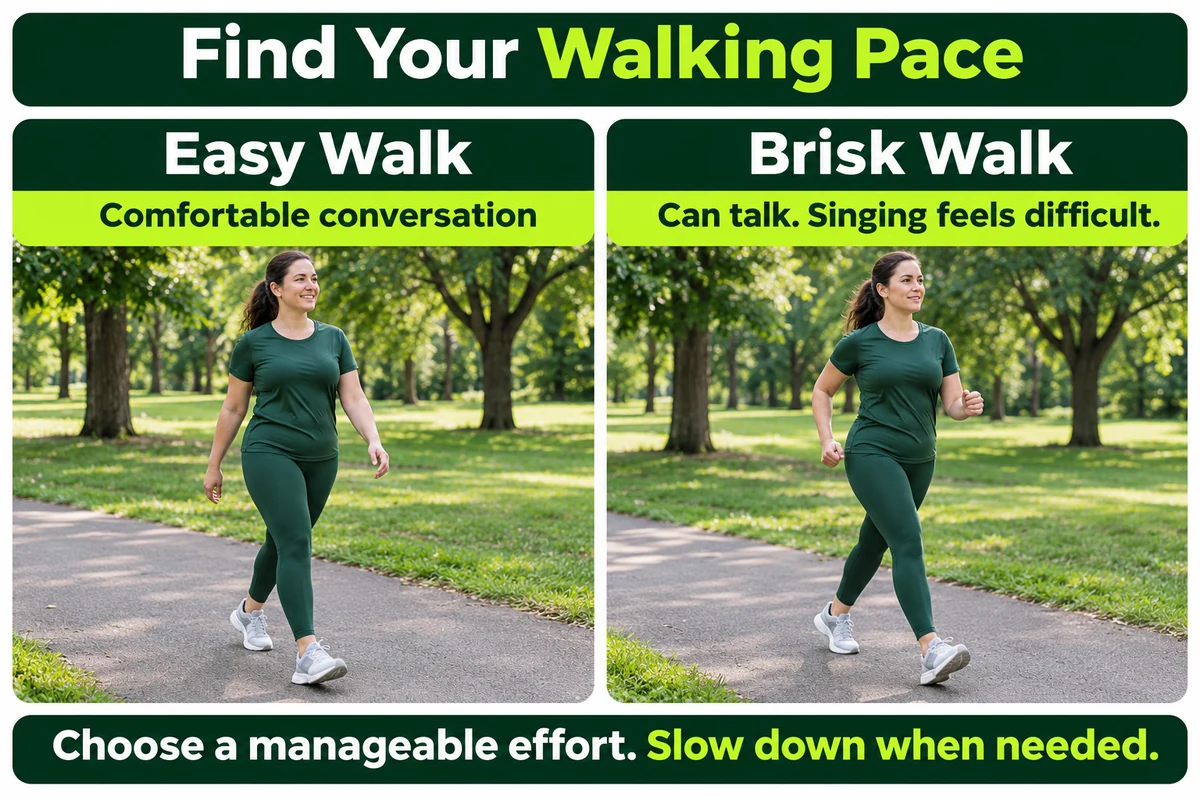
Use the talk test
The CDC description of activity intensity explains that moderate activity allows talking but makes singing difficult. At vigorous intensity you can manage only a few words before pausing for breath. Use that as an approximate check during uninterrupted walking.
If you are gasping during a beginner session then slow down or stop as appropriate. Brisk does not mean pushing to your limit. Your breathing should match a challenge you can manage while still paying attention to your surroundings and walking with control.
| Walking effort | How it may feel | Practical role |
|---|---|---|
| Easy | Comfortable conversation and little breathing change | Starting practice and easier portions of a session |
| Moderate | You can talk but singing is difficult | Building moderate intensity aerobic minutes |
| Too demanding for the planned session | You cannot maintain comfortable control or the intended effort | Reduce pace or pause rather than forcing the plan |
The table is an effort guide rather than a diagnostic test. Unusual breathlessness or chest discomfort needs attention rather than a different pace calculation. If you have a condition that affects exercise response then use the guidance provided by your clinician.
Prepare for your first fitness walk
You do not need to buy a full set of equipment. Remove the obvious barriers first. Decide where you will go and how long you will be away. Make the first route simple enough that navigating it does not become the main challenge.
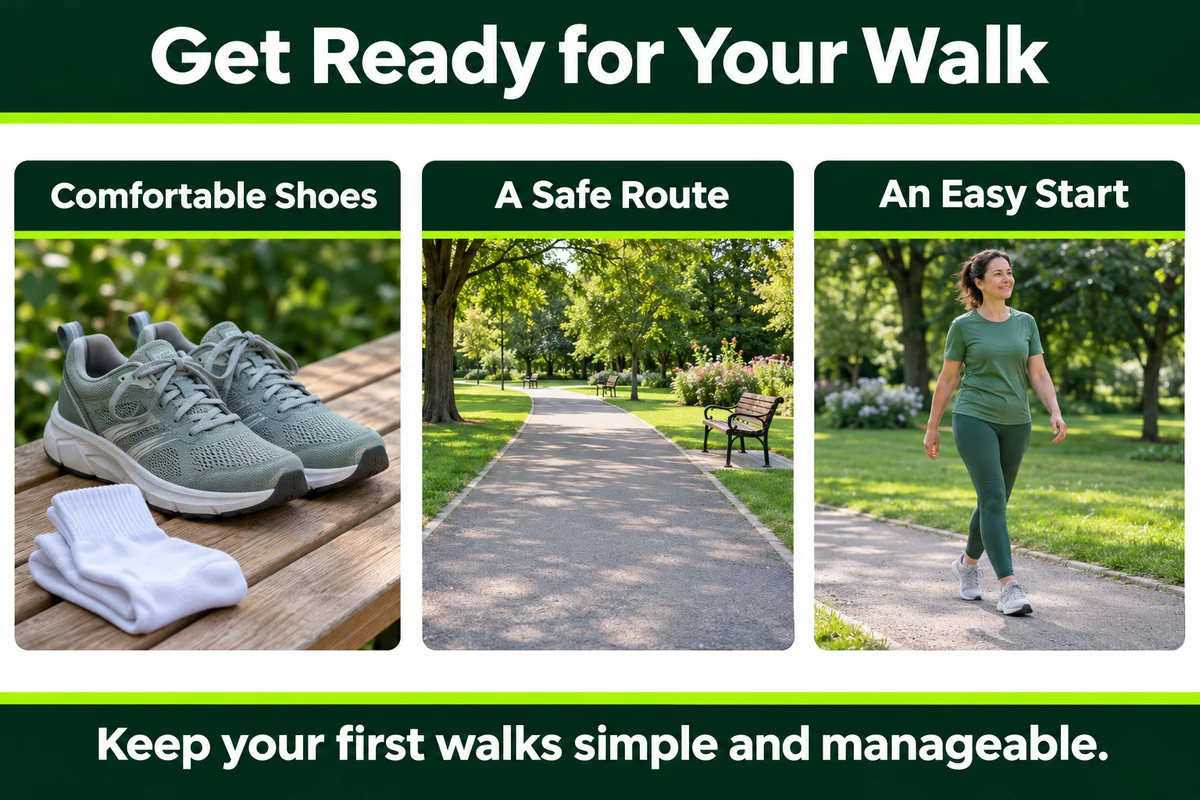
Choose comfortable footwear
Use shoes that fit securely and feel comfortable for the route. Check for rubbing and enough room around the toes. A new pair is not automatically an improvement. Test unfamiliar footwear on a short outing rather than a longer session far from home.
Choose a route with an easy exit
A short loop near home lets you stop without a long return journey. A route with benches or convenient resting places can also help. Consider crossings and lighting and surface conditions before looking at distance. A less scenic but predictable path may be the more useful first option.
Make the appointment specific
Replace an intention such as walk more with a concrete plan. For example you might walk the short park loop after lunch on Monday and Wednesday and Saturday. Keep a shorter version available if time becomes tight. That reduces the need to renegotiate the entire routine each day.
A simple structure for each walking session
Begin easily and finish gradually instead of stepping straight into your fastest pace. The American Academy of Orthopaedic Surgeons exercise walking guidance describes an easy walking warm up and cool down around the more purposeful portion. Its example uses five minutes for each.
The following 20 minute session is an organizational example for someone who can comfortably manage that total time. It is not a minimum session length. A shorter walk can remain entirely easy when you are first finding your starting point.
- Walk easily for 5 minutes and let breathing increase gradually.
- Walk at a manageable moderate effort for up to 10 minutes if appropriate.
- Reduce your pace for the final 5 minutes.
- Record the total time and how the session felt.
In this example the whole session lasts 20 minutes but only the 10 minute middle portion is planned as moderate activity. Do not automatically log all 20 minutes toward the moderate intensity target. Actual effort determines what belongs in that total.
Keep your movement natural
Look ahead often enough to see the route rather than staring at a phone. Let your arms move comfortably and keep your shoulders relaxed. Avoid deliberately reaching far ahead with each step. If trying to walk faster makes you feel awkward then ease back and focus on a smooth rhythm.
Check comfort before chasing pace
Notice whether you are limping or changing your stride to avoid discomfort. That is a reason to reassess rather than a challenge to overcome with willpower. Footwear and surface and session length are practical details to review. Persistent or recurring pain deserves appropriate professional assessment.
A flexible four stage beginner walking plan
The table below uses stages rather than deadlines. You might spend one week at a stage or repeat it for longer. These are suggested total outing times. They include any easy beginning and ending and do not imply that every minute is moderate intensity.
| Stage | Planned outings | Total time per outing | Main focus |
|---|---|---|---|
| 1 | 3 days | 5 to 10 minutes | Find a comfortable route and repeatable time |
| 2 | 3 days | 10 to 15 minutes | Add time if the starting walks feel manageable |
| 3 | 4 days if appropriate | 10 to 15 minutes | Add an outing without also extending every walk |
| 4 | 4 days | 15 to 20 minutes | Include manageable brisk portions when ready |
The final stage contains 60 to 80 total walking minutes. It is therefore a foundation rather than a complete 150 minute moderate intensity week. Continue developing capacity afterward. Repeating a stage is a valid adjustment and does not mean you have fallen behind.
Change one main element at a time
If you add a fourth outing then keep the existing duration stable initially. If you lengthen a walk then keep the pace familiar. Changing everything together makes it harder to understand which adjustment caused excessive fatigue or a scheduling problem.
Use the next day as useful feedback
Ask whether ordinary walking still feels comfortable and whether you are ready for the next planned session. Mild tiredness and a major disruption to everyday activity are different experiences. If the new dose feels too much then return to the previous manageable level while reviewing the cause.
Build toward a week with 150 moderate minutes
After developing a consistent routine you can distribute moderate walking across the week. The example below separates the purposeful walking from additional easy time. It is a destination example rather than a schedule every beginner should start tomorrow.
| Day | Planned moderate walking | Organization |
|---|---|---|
| Monday | 30 minutes | One walk or shorter separate walks |
| Tuesday | 20 minutes | Choose a familiar level route |
| Wednesday | 0 planned minutes | Rest from structured walking or move easily |
| Thursday | 30 minutes | Divide into shorter periods if useful |
| Friday | 20 minutes | Keep effort manageable |
| Saturday | 30 minutes | Choose a convenient route you enjoy |
| Sunday | 20 minutes | Complete the planned weekly amount |
The arithmetic is 30 plus 20 plus 30 plus 20 plus 30 plus 20 which equals 150 minutes. Easy warm up and cool down time is additional unless it actually reaches moderate effort. You can use a different distribution that suits your schedule.
Do not rush to replace all easy walking with brisk walking. Keep a mix that supports comfort and consistency. If your routine also includes cycling or swimming then suitable moderate minutes from those activities can contribute toward the same aerobic total.
Should you track steps or minutes?
Both can help but they answer different questions. Minutes can describe the duration of a planned session. Steps can reveal patterns in everyday movement. A large daily step total does not tell you how much time you spent walking at moderate effort.
You do not need 10000 steps before activity counts
NIH reporting on step count research explains that health benefits have been observed below the widely promoted 10000 step target. Those findings do not create one perfect step prescription for every reader. They do challenge the idea that a lower total is automatically worthless.
Use your own baseline
If tracking is helpful then observe a few ordinary days before choosing a goal. Include both busier and quieter days. Add a manageable outing to that existing pattern instead of selecting a large number because it appears as a default in an app.
Keep device estimates in perspective
A phone left on a desk cannot capture every step you take. Devices can also record movement differently. Compare your own trends using a consistent method rather than treating small differences between devices as meaningful fitness changes. You can follow a useful routine without a tracker.
Walking outdoors or indoors or on a treadmill
The most useful location is one you can access safely and repeat regularly. Each option creates different practical demands. Match the route to your current comfort and conditions instead of assuming that an outdoor hill or a treadmill incline is inherently better.
| Setting | Useful feature | Practical limitation | Beginner adjustment |
|---|---|---|---|
| Outdoor path | Fresh surroundings and a natural destination | Weather and crossings and uneven surfaces | Start on a predictable route close to home |
| Indoor corridor or public walking space | A weather protected option | Space and opening hours and other people | Use permitted areas with a clear path |
| Treadmill | Adjustable speed and predictable surface | Moving belt and unfamiliar controls | Learn the stop function and start slowly |
On a treadmill follow the machine instructions and use the safety system. Do not step onto a fast moving belt or turn around while walking. If balance is uncertain or you need substantial support then seek appropriate guidance before increasing speed or incline.
Small indoor spaces still need attention
Clear loose rugs and obstacles. Choose a route that does not require constant sharp turns at speed. If the available space is awkward then shorter comfortable bouts may be more appropriate. Do not create a trip hazard simply to complete a time target.
Add variety after the basic routine feels comfortable
You do not need weighted vests or difficult terrain to make progress. Start by making the existing routine more dependable. Later you can change the route or include a few controlled brisk portions. Keep the purpose of the session clear.
Try easy and brisk sections
For an adult already comfortable with continuous walking one option is to alternate a short brisk section with an easier section. For example you could walk briskly for one minute and easily for two minutes a few times. Keep the brisk portion moderate rather than turning it into a sprint.
This is an optional example rather than a required workout. Use a flat familiar route and enough easy time at the beginning and end. If the changes in pace feel uncomfortable then return to steady walking. Intervals are a tool for variety rather than a sign that ordinary walks have stopped working.
Treat hills as a separate increase in demand
A hill can raise effort without much change in speed. Shorten the route or slow down if you introduce one. Downhill sections also require control and attention to footing. Avoid combining a longer route and a faster pace and new hills in the same first attempt.
Safety and recovery deserve a place in the plan
Most healthy adults can begin gentle activity without extensive testing. Existing symptoms or injuries or health conditions can change the advice. If you have been given exercise restrictions then use those rather than a generic walking table.
Stop for warning symptoms. Stop walking if you develop chest pain or pressure or feel faint or experience severe unusual breathlessness. Seek urgent medical help for severe or persistent symptoms. Recurring dizziness or pain also needs assessment before continuing.
The NIDDK advice on staying active includes stopping for symptoms such as dizziness and chest pain rather than trying to push through.
Make outdoor visibility part of preparation
The CDC guidance on safer walking and rolling recommends improving visibility with bright or reflective clothing and using lights in darkness. Prefer suitable paths and crossings and stay aware of traffic. Do not let a phone or loud audio take your attention away from the route.
Adapt to heat and poor conditions
Choose a cooler time or an indoor option when conditions make an outdoor walk unsuitable. Bring water when the outing and weather call for it. There is no fixed drinking amount that fits every walk and person. Follow individual fluid guidance if a clinician has given you one.
Respond to rubbing early
If a shoe begins rubbing then stop and inspect the problem instead of hoping it disappears over a longer route. Keep the next outing short while you assess footwear and socks. People with reduced foot sensation or diabetes may need specific foot care advice before adopting a new walking routine.
Walking for weight management without unrealistic promises
Walking uses energy but the amount depends on body size and pace and terrain and duration. A fixed promise about calories burned per mile will not fit every reader. Treat a device calorie estimate as an approximation rather than an exact allowance for additional food.
Weight management involves eating patterns and total activity and other individual factors. Walking can support a useful routine without guaranteeing a particular weekly weight change. Avoid judging every session by the next morning’s scale reading. Notice consistency and comfort and growing capacity too.
Keep ordinary nutrition practical
For a short routine walk most people do not need a special sports product. Fit the outing around normal meals in a way that feels comfortable. If you have a condition that affects blood glucose or need specific nutrition around activity then follow your care plan.
What to do when the routine gets interrupted
You only have five minutes
Use a short safe route rather than abandoning the day. Keep the pace appropriate and avoid rushing through crossings to fit more distance into the time. A shorter outing can preserve the appointment while you return to the usual routine on another day.
You miss several outings
Resume with a manageable session instead of trying to repay missed minutes. If you have been ill or inactive for longer then reduce duration or effort and reassess. The calendar does not require you to return at precisely the level you reached before the interruption.
You keep running out of time
Review the whole appointment including preparation and travel. A nearby route may work better than a distant park. Place walking next to an existing habit such as a lunch break. Keep the plan specific enough to start but flexible enough to survive a busy week.
You feel bored
Change the route slightly or walk with someone whose pace suits yours. You can also set a practical destination such as returning a library book. Keep awareness of the surroundings if listening to audio. Enjoyment supports repetition but should not create a distraction problem.
Use a weekly review to decide what comes next
A brief record can tell you more than an ambitious plan you never inspect. Note the outing time and any brisk portions and how you felt afterward. You do not need precise GPS data to discover that a particular hill or schedule is making walks harder to repeat.
Before increasing the challenge review these questions using real examples from the week. Look for a pattern rather than judging yourself by one unusually tired day. The purpose is to choose a manageable next step rather than prove that you worked hard enough.
- Did the planned walking times fit your ordinary responsibilities?
- Could you move comfortably without changing your stride to avoid pain?
- Did the chosen pace match the purpose of the session?
- Were you comfortable returning for the next planned outing?
- Would a small increase help or should you repeat the current stage?
If the routine is manageable then add a small amount to one element. If it is not then shorten a walk or repeat the same stage. A workable adjustment is more useful than a perfect looking progression that ignores the feedback your week provides.
Frequently asked questions about walking for fitness
Is walking enough exercise for a beginner?
It can provide a useful aerobic starting point. A balanced adult activity routine also includes strengthening work and may include balance training where appropriate. Build those elements according to your capacity rather than assuming a longer walk automatically covers every fitness need.
Should you walk every day?
You can include comfortable movement daily if it suits your circumstances. You do not have to complete a demanding walk every day. Planned easier days and rest from structured sessions can help make a routine manageable. Adjust based on recovery rather than a streak counter.
Is a short walk worth doing?
Yes. A shorter outing can contribute to an active day and help build the habit. If the effort is moderate those minutes can contribute toward the aerobic target. A comfortable easy walk can still be an appropriate starting step when brisk walking is currently too demanding.
Do you need to walk faster each week?
No. You can progress by repeating the routine more consistently or extending a manageable session. Speed is only one variable. If a faster pace disrupts control or makes the intended effort too demanding then maintain or reduce it instead.
When will you notice progress?
There is no reliable deadline for every person. Review a familiar route over several weeks and notice whether effort or pauses or duration changes. Do not compare a cool flat walk with a hot uphill outing and conclude that your fitness has suddenly declined.
Plan your next walk
Choose a safe route and a realistic time. Start at a comfortable pace and keep the first outing short enough to repeat. Record how it felt and use that information to plan the next one. You can develop a walking routine without buying specialized equipment or meeting an arbitrary step target.
Over time work toward more appropriate aerobic activity alongside strengthening and adequate recovery. The useful starting question is simple. What walk can you comfortably fit into your next ordinary day?
Sources and editorial scope
The official health and professional organization sources linked above support the general activity targets and effort descriptions and safety advice. Progression stages and weekly schedules are original educational examples rather than individualized prescriptions or claims of personal testing. Sources were checked on November 5 2026.